
Moving Averages: The Difference Between EMA and SMA for Nifty Scalping
If you open the TradingView chart of almost any technical trader in the world, you will see a squiggly line trailing behind the price. Moving averages are the undisputed bread and butter of market analysis.
But when a beginner starts setting up their charts to trade Nifty 50 options, they immediately run into a confusing choice: Should you use the Simple Moving Average (SMA) or the Exponential Moving Average (EMA)?
For a long-term mutual fund investor, the difference is practically zero. But for an intraday options buyer trying to scalp 20 points out of a fast Nifty breakout, choosing the wrong moving average can completely destroy your entry timing.
Here is exactly how they differ, and why one is vastly superior for intraday scalping.
The Simple Moving Average (SMA): The Smooth Operator
The math behind the SMA is exactly what it sounds like—simple.
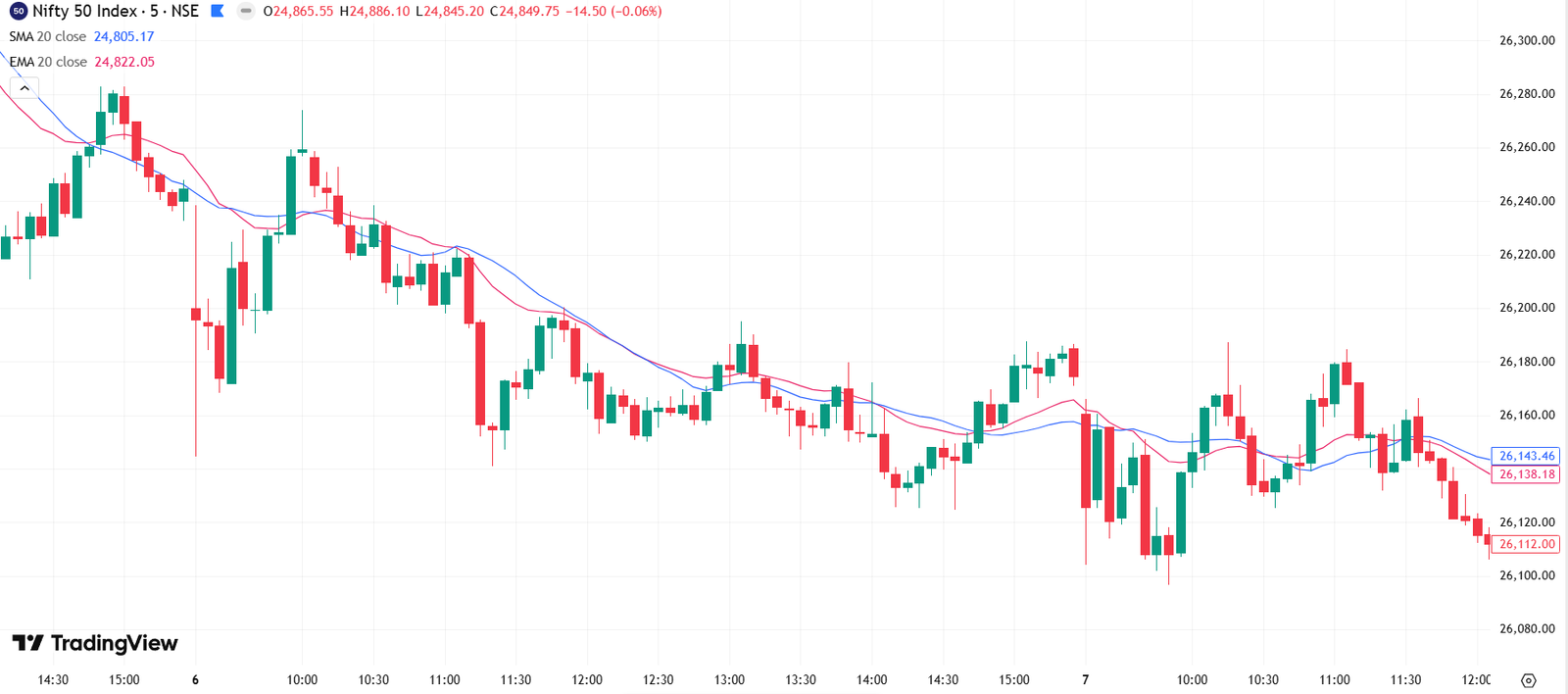
If you put a 20-period SMA on your 5-minute Nifty chart, the indicator takes the closing prices of the last 20 candles, adds them together, and divides by 20. Every single candle holds the exact same weight. The candle from 100 minutes ago is treated as just as important as the candle that closed 1 second ago.
- The Benefit: It creates a very smooth, reliable line that is great for identifying major, long-term support and resistance zones.
- The Drawback for Scalping: It is incredibly slow to react. We call this “lag.” If the Nifty suddenly spikes 80 points on a sudden news event, the SMA will take several candles to slowly bend upward.
The Exponential Moving Average (EMA): The Speed Demon
The EMA was designed specifically to fix the lagging problem of the SMA.
While it still calculates an average over your chosen period, the EMA throws extra mathematical “weight” onto the most recent candles. The older the data gets, the less it matters.
- The Benefit: It reacts to sudden price changes almost instantly. It “hugs” the candlesticks much tighter than an SMA.
- The Drawback: Because it is so sensitive, it can sometimes trick you into a fake breakout during choppy, sideways markets.
Why Intraday Scalpers MUST Use the EMA
When you are buying Nifty weekly options (CE or PE), time is your worst enemy due to premium decay (Theta). You cannot afford to wait 15 minutes for your moving average to cross. You need to enter the exact second the momentum shifts.
Let’s say you are trading a 3-minute timeframe. If you wait for the slower SMA to confirm a trend reversal, the move is probably already halfway done. The premium has already spiked, and if you enter then, your risk-to-reward ratio is terrible.
The EMA gets you into the trade faster, allowing you to catch the meat of the momentum spike before the rest of the retail crowd figures out what is happening.
A Practical Setup: The 9 EMA Trend Rider
One of the most powerful ways to use the EMA for Nifty scalping is for trade management (knowing when to exit).
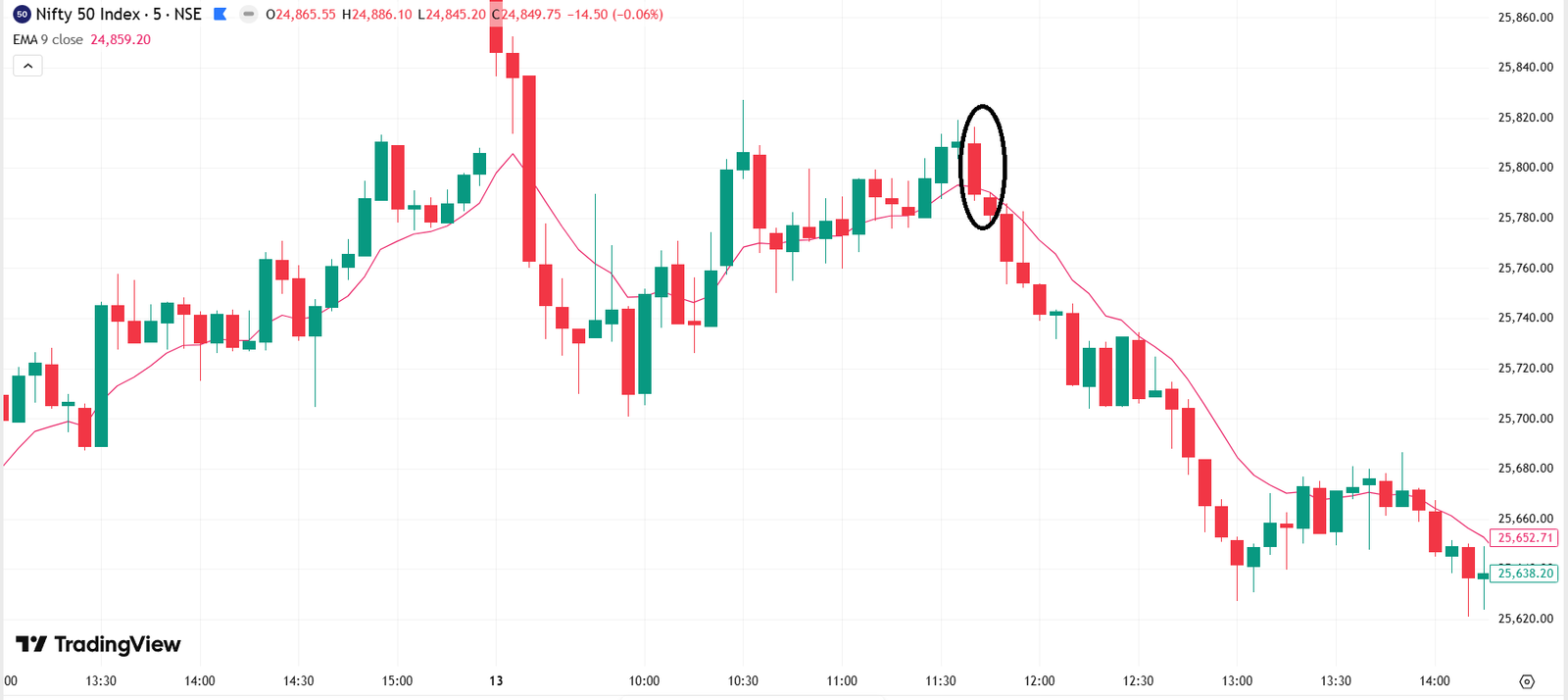
Many professional scalpers use the 9-period EMA on a 3-minute or 5-minute chart.
- The Entry: You enter your Call or Put based on your primary strategy (like an ORB breakout, or a VWAP bounce).
- The Hold: As long as the Nifty candles are closing above the 9 EMA (for a Call trade), you hold your position and ride the massive trend.
- The Exit: The absolute second a 3-minute candle closes below the 9 EMA, the short-term momentum is broken. You sell your options and book your profit instantly.
Conclusion
Stop using SMAs for 3-minute or 5-minute charts. Leave the Simple Moving Average for your daily and weekly investment analysis. When you are sitting at your desk at 9:15 AM ready to scalp options, speed is everything. Switch your settings to the Exponential Moving Average, tighten up your trailing stop losses, and follow the immediate momentum.