
The Reality of Algorithmic Trading: What Retail Traders Need to Know About Automation
If you scroll through financial social media, you will see endless ads promising “fully automated trading bots that make money while you sleep.” They make it sound like you just click a button, walk away, and an Artificial Intelligence prints cash from the stock market.
As someone who actually builds and codes multi-account trading terminals, let me give you the unfiltered truth: Real algorithmic trading is not a passive income machine. It is a highly technical, maintenance-heavy business.
Here is what retail traders actually need to know before they try to automate their Nifty or Sensex execution.
What “Algo Trading” Actually Is
For a retail trader, algorithmic trading rarely involves complex machine learning or AI predicting the future. It is simply Automated Execution.
It means taking a strict set of rules—like “Buy a Nifty Call when the 5-minute candle closes above the VWAP”—and writing code that tells your broker to execute that trade without you having to click the mouse.
It removes the human hesitation and the slippage of manual entry, but the logic still comes entirely from the trader. If your underlying strategy is unprofitable, automating it will just help you lose your money at lightning speed.
The Retail Tech Stack
To automate your trades, you don’t need to be a Wall Street quantitative analyst, but you do need a robust tech stack. A standard, reliable setup for a retail trader usually looks like this:
- The Logic Engine: You write your technical strategy using Pine Script on TradingView. This is where the chart analysis happens.
- The Bridge (Webhooks): When your Pine Script conditions are met, TradingView fires a “Webhook” (a digital data packet) containing the trade details.
- The Backend Terminal: This is where Python comes in. You need a backend application (often built with custom UIs using libraries like Tkinter) running on your computer or a cloud server. This software receives the Webhook, processes the logic, and manages your risk parameters.
- The Broker API: Your Python software instantly communicates with your broker (Zerodha, Dhan, Fyers, etc.) via their API to place the SL-Limit orders across one or multiple accounts in milliseconds.
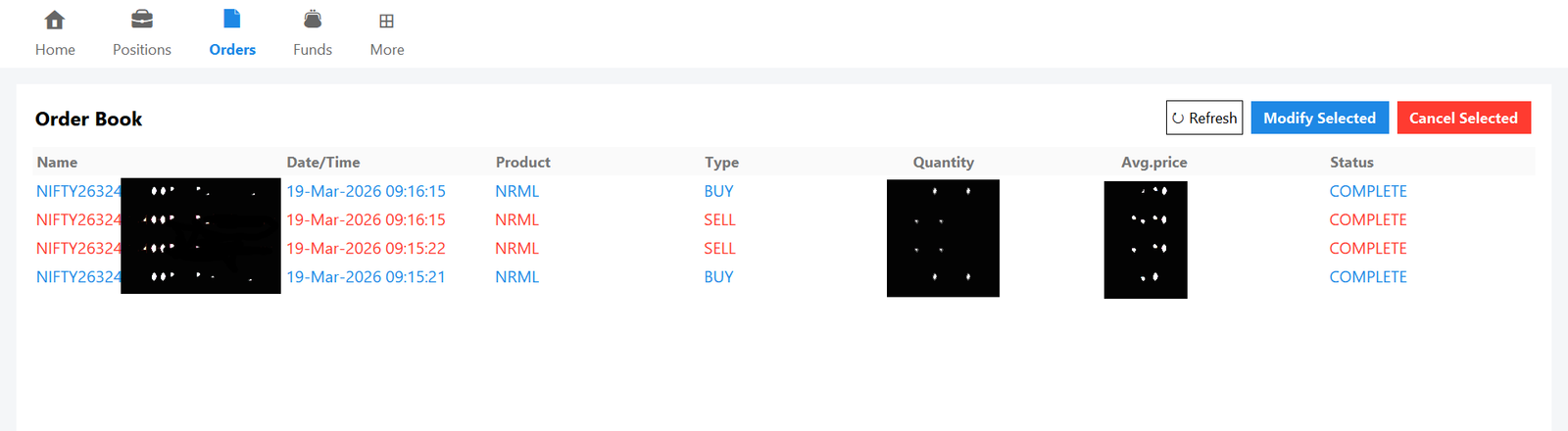
The Hidden Risks of Automation
If you are going to automate, you have to monitor your infrastructure like a hawk.
- API Disconnects: Broker APIs go down. Tokens expire. If your system fires a “Sell” signal but the broker API is unresponsive, you are left holding a naked options position while the market crashes.
- Latency: If your server takes 2 seconds to process the data, the Nifty options premium might have already spiked 15 points.
- The “Fat Finger” Code: A single misplaced decimal in your position sizing code can cause your software to buy 1,000 lots instead of 10.
Start Semi-Automated
If you are tired of manual slippage but aren’t ready to trust a fully automated bot with your life savings, the best middle ground is Semi-Automation.
Code a system that does the heavy lifting: let your software scan the charts, calculate the exact lot size based on your account balance, and prepare the SL-Limit order ticket. But leave the final “Confirm Trade” button to a human click.
Automation is the ultimate execution edge, but it requires treating your trading like a professional software engineering project.