
How to Read the Put-Call Ratio (PCR) for Intraday Reversals
If you are only looking at green and red candles to make your trading decisions, you are always going to be one step behind the smart money. Candlesticks show you what has already happened. To predict what is going to happen next, you have to look under the hood of the market.
You need to know where the massive institutional option sellers have parked their capital. The fastest, most accurate way to do this is by reading the Put-Call Ratio (PCR).
For retail traders, PCR is often misunderstood. But once you learn how to read its extremes, it becomes the ultimate cheat code for catching massive, high-probability intraday reversals on the Nifty 50 and Bank Nifty.
What Exactly is the PCR?
The Put-Call Ratio is a simple mathematical formula: Total Put Open Interest ÷ Total Call Open Interest = PCR
To use this correctly, you must think like an Option Seller.
- When institutions are bullish, they sell (write) Put options. This creates a massive amount of Put Open Interest, pushing the PCR higher.
- When institutions are bearish, they sell Call options. This creates massive Call Open Interest, pushing the PCR lower.
Therefore:
- A PCR of 1.0 is perfectly neutral.
- A PCR above 1.0 is bullish (more Puts are being sold).
- A PCR below 1.0 is bearish (more Calls are being sold).
The Reversal Secret: Reading the Extremes
Here is the trap that destroys amateur data traders: They see the PCR hit 1.3, assume the market is incredibly bullish, and blindly buy Call options. Five minutes later, the market crashes, and they are left holding worthless premiums.
Why did it crash? Because the market is a rubber band, and the PCR tells you when that rubber band is about to snap. You do not use the PCR to follow the trend; you use it to fade the trend.
1. The “Oversold” Bounce (Hunting for Bottoms)
When the Nifty is in a brutal morning downtrend, retail traders panic and buy Put options. The institutions happily sell them those Calls.
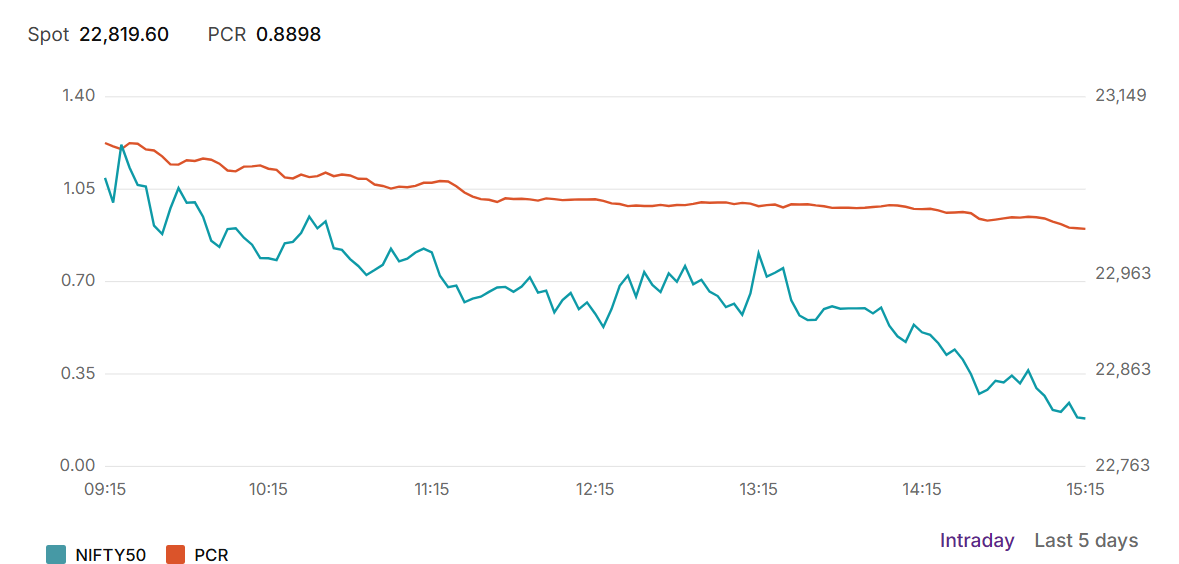
If the PCR drops down to 0.60, 0.50, or even 0.45, the market is mathematically oversold. Every single person who wants to be short is already short. There are no sellers left. At this extreme level, the slightest bit of buying volume will trigger a massive short-covering rally.
2. The “Overbought” Crash (Hunting for Tops)
If the Bank Nifty has been rallying all morning and the PCR climbs up to 1.40, 1.50, or 1.60, the market is dangerously overbought.
At 1.50, there is massive complacency. Everyone thinks the market will go up forever. This is exactly when smart money starts quietly booking profits. A PCR this high is a massive warning siren: Do not buy breakouts. Instead, start looking for bearish reversal candlestick patterns (like a Shooting Star) at major resistance levels to ride the inevitable crash back down.
How to Trade the PCR Divergence
The highest-probability trade setup in the entire Indian options market is the PCR Divergence.
Here is how you spot it:
- It is 1:00 PM. The Nifty makes a new low on the chart.
- You check your Option Chain data. Even though the price made a new low, the PCR actually went up (e.g., it moved from 0.55 to 0.65).
- This is a massive hidden signal. It means that while the price was dropping, institutional Option Writers were actually heavily selling Puts at the bottom to absorb the retail panic. They are building a floor.
- The Execution: Wait for the next 5-minute candle to break above the VWAP or a local pivot point, and buy your Call (CE) option. The trap has been set, and you are trading alongside the puppet masters.
Do Not Trade Data Blindly
The PCR is a compass, not a trigger. Never buy or sell a Nifty option just because the PCR hit 0.50. The market can stay irrational longer than you can stay solvent.
Use the PCR to form your bias. Once the PCR hits an extreme level, switch to your price action charts, wait for your technical setup (like a trendline break or an inside bar breakout) to confirm the reversal, and then execute with strict risk management.