
Scaling Up: Risk Management Rules for Executing Trades Across Multiple Broker Accounts
Every retail trader dreams of the day their backtested Nifty 50 strategy finally clicks. You master the Opening Range Breakout (ORB), you understand premium decay, and you start pulling consistent active income from the market.
Then comes the next logical step: Scaling up.
If your system makes money with 1 lot, it should make money with 100 lots, right? Mathematically, yes. Psychologically, no. Seeing a ₹500 intraday loss is easy to handle. Seeing a ₹50,000 loss in a single red candle will make your hands shake, causing you to abandon your rules and exit early.
To bypass this psychological barrier, professional systematic traders use Multiple Broker Accounts. Instead of trading 100 lots on one broker, they trade 20 lots across 5 different brokers simultaneously. But doing this safely requires strict rules and the right technology.
Why Use Multiple Accounts? (The “Broker Glitch” Hedge)
Psychology isn’t the only reason to split your capital. In the Indian stock market, broker downtime is a very real risk.
Imagine you are heavily long on Nifty Call options, and the market suddenly reverses. You try to hit the “Exit” button, but your broker’s app freezes. By the time the system recovers 10 minutes later, your capital is wiped out.
By distributing your capital across different APIs (like Zerodha, Fyers, Dhan, etc.), a technical failure at one broker only affects a fraction of your portfolio. It is the ultimate infrastructural hedge.
Rule 1: The Automation Mandate
You cannot trade multiple accounts manually. If you try to open 5 different browser tabs and frantically click “Buy Market” on each one during a fast Nifty breakout, you will suffer massive slippage. By the time you reach the 5th tab, the premium will have already skyrocketed.
You must use a centralized trading terminal or custom-built software (like a Python-based GUI) that connects to broker APIs. When your strategy triggers a buy signal, your software should blast the order to all 5 accounts in the exact same millisecond.
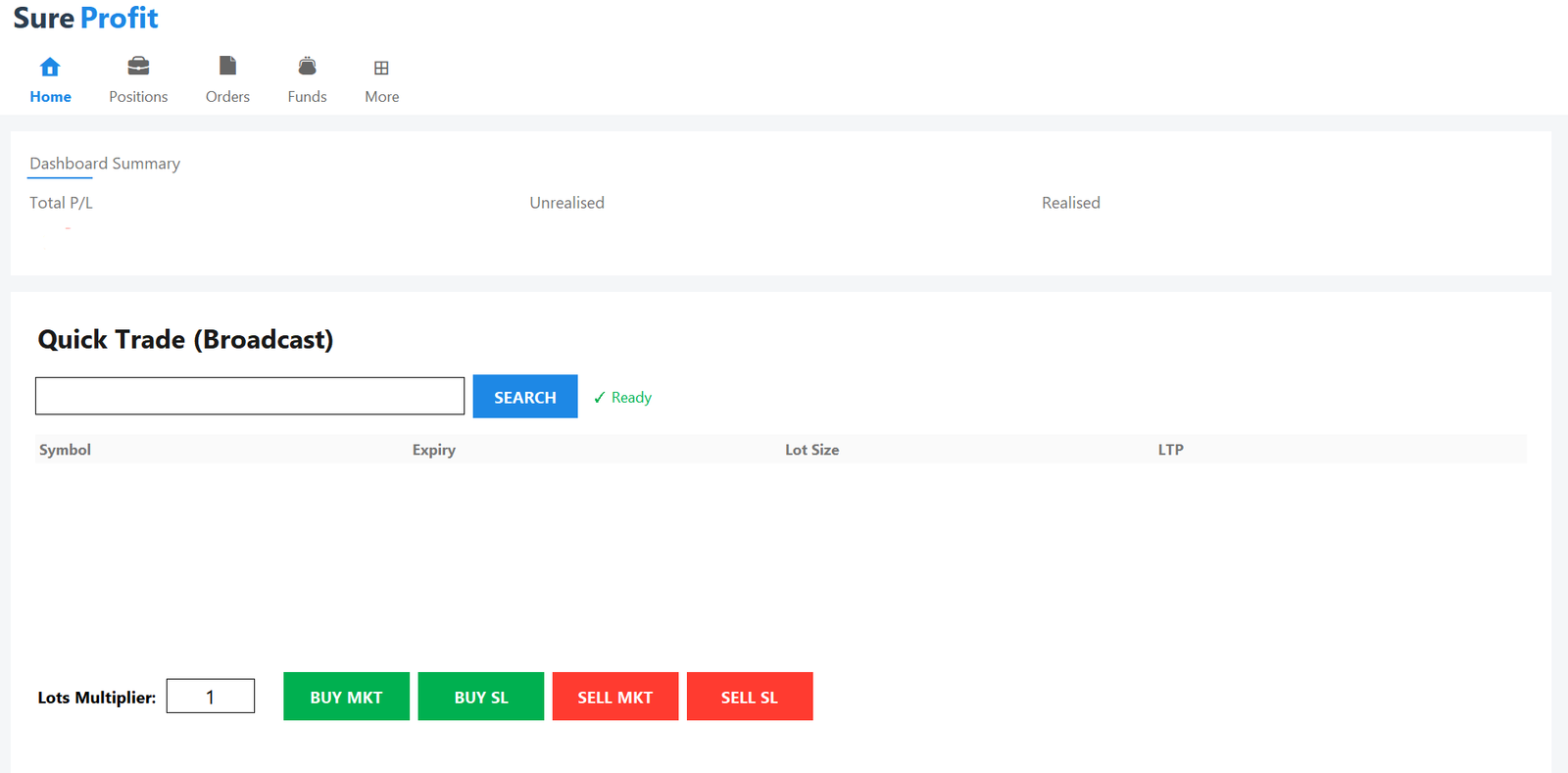
Rule 2: Synchronized Position Sizing
When scaling across accounts, keep your risk profile identical. If you are risking 2% of your capital on a trade, that 2% rule must apply equally across all accounts.
Do not treat one account as the “safe” account and another as the “gambling” account. Let the math of your backtested system dictate the lot size uniformly. If your custom indicator prints a verified Green Arrow, the execution should be a copy-paste across your entire infrastructure.
Rule 3: The “Kill Switch” (Centralized Stop Loss)
This is the most critical risk management rule for multi-account trading.
When you have positions open across several brokers, monitoring individual stop losses is a nightmare. You need a centralized “Square Off All” button built into your trading software.
If a sudden, violent news event hits the market and the Nifty breaks a major weekly trendline against your position, you do not have time to log into different apps. You need one master button that instantly cancels all pending orders and fires SL-Limit exit orders to every connected API to protect your capital.

Conclusion
Scaling up is not about blindly throwing more money at the market. It is about engineering a robust, fail-safe system that protects your downside while maximizing your edge. Build your tools, respect your risk limits, and let your automated software do the heavy lifting while you focus purely on the price action.