
Stop Buying Cheap Options: The Mathematical Reality of ITM, ATM, and OTM Strikes
If you look at the trading history of a beginner who just blew up their first Nifty 50 account, you will almost always find the exact same mistake. They didn’t necessarily get the market direction wrong. They just bought the wrong strike price.
Retail traders love cheap things. When they open the Option Chain on a Thursday morning and see a Nifty Call option trading for ₹5, they think, “Wow, if this goes to ₹50, I’ll make 10x my money!” This is the “Lottery Ticket Trap.” In the Indian derivatives market, cheap options are cheap for a reason: they are mathematically designed to expire worthless. If you want to stop bleeding your capital to Theta decay and start catching real momentum, you have to understand the Greeks—specifically, Delta.
Here is the unfiltered truth about choosing between In-The-Money (ITM), At-The-Money (ATM), and Out-Of-The-Money (OTM) strikes.
The Illusion of OTM (Out-Of-The-Money) Options
An OTM option is a strike price that the market has not reached yet. If Nifty is at 22,000, the 22,500 Call is deep OTM.
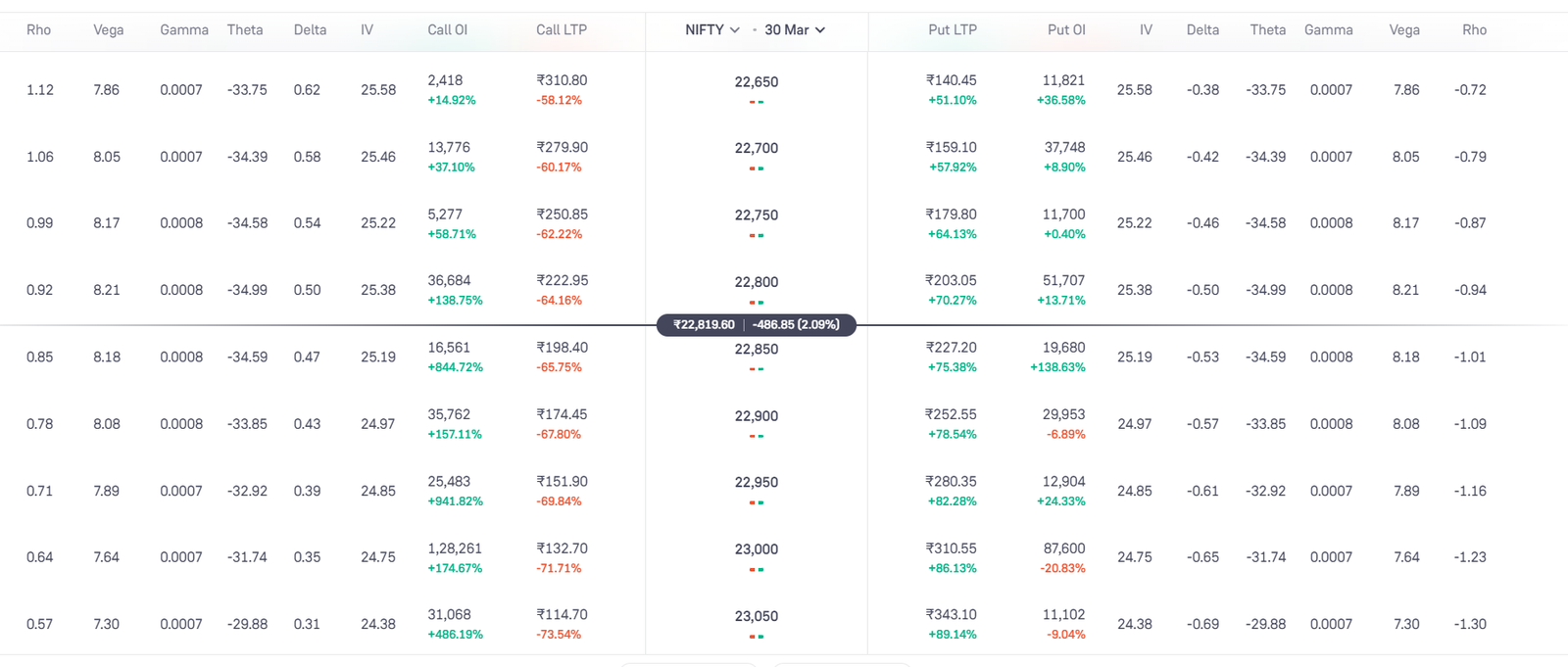
- The Delta Problem: Delta measures how much your option premium will move for every 1-point move in the underlying index. Deep OTM options have a Delta of around 0.10 or 0.20.
- The Reality: If you buy a cheap OTM Call and the Nifty moves 50 points in your favor, your premium will only go up by 5 or 10 rupees. But because OTM options are made entirely of “Extrinsic Value” (time value), Theta is actively melting that premium away every minute. You need a massive, violent 200-point rally just to break even.
- The Verdict: Never buy OTM options for intraday scalping unless you are trading a highly calculated Gamma blast at 2:30 PM on expiry day.
The ATM Sweet Spot (At-The-Money)
An ATM option is the strike price closest to where the market is currently trading. If Nifty is at 22,050, the 22,000 or 22,100 strikes are ATM.
- The Delta Advantage: ATM options usually have a Delta of around 0.50. This means if the Nifty shoots up 50 points on an Opening Range Breakout, your option premium will jump roughly 25 points.
- The Liquidity: This is where all the institutional volume is. The bid-ask spread is incredibly tight, meaning you won’t lose money to slippage when you hit the buy or sell button.
- The Verdict: If you are an intraday day trader executing 5-minute to 15-minute momentum setups (like VWAP bounces or ORB), ATM is your absolute best friend. It balances reasonable cost with high responsiveness.
The ITM Power Play (In-The-Money)
An ITM option has already been crossed by the market. If Nifty is at 22,200, the 22,000 Call is deeply In-The-Money.
- The Intrinsic Value: ITM options are expensive because they contain real, tangible “Intrinsic Value.” They aren’t just based on hope and time.
- The High Delta: Deep ITM options have a Delta of 0.80 to 1.00. If the Nifty moves 50 points, your option premium moves 40 to 50 points. It behaves almost exactly like trading the Future contract, but with strictly capped risk.
- The Verdict: If you are taking a positional swing trade—meaning you plan to hold the option overnight or for a few days—you must use ITM options. The high intrinsic value acts as a shield against the overnight Theta decay that destroys ATM and OTM buyers.
Stop treating the stock market like a casino. You are paying for probability. Buy the ATM strikes for day trading, buy the ITM strikes for swing trading.