
The Truth About “Zero to Hero” Trades: How to Catch Expiry Day Gamma Blasts Safely
If there is one phrase that has destroyed more retail trading accounts in India than anything else, it is “Zero to Hero.”
Every Tuesday afternoon during the Nifty weekly expiry, retail traders flock to their broker terminals hoping to turn a ₹5 option premium into ₹50. They see screenshots on social media of 1000% returns and think it is an easy lottery ticket.
The reality? 95% of the time, that ₹5 option goes straight to zero, and the option sellers happily pocket the premium. But that remaining 5% of the time, massive “Gamma Blasts” actually do happen. If you want to trade them, you have to stop treating them like gambling and start treating them like a calculated mathematical system.
The Math Behind the Move: What is Gamma?
To understand the 2:30 PM expiry move, you need to understand Gamma.
Gamma is the “accelerator pedal” for an option’s price. On expiry day, as the clock ticks closer to 3:30 PM, the Gamma on Out-Of-The-Money (OTM) options goes absolutely crazy. If the Nifty spot price suddenly makes a violent 50-point spike toward your OTM strike, Gamma forces the option premium to explode in value instantly to catch up.
What causes that sudden 50-point Nifty spike? Forced Short Covering.
The Anatomy of a Gamma Blast
A true Zero-to-Hero trade only happens when large institutional option sellers are forced to panic and buy back their positions.
Here is the exact setup you should look for:
- The Round Number Squeeze: Look at a major psychological level on the Nifty (like 22000 or 22500).
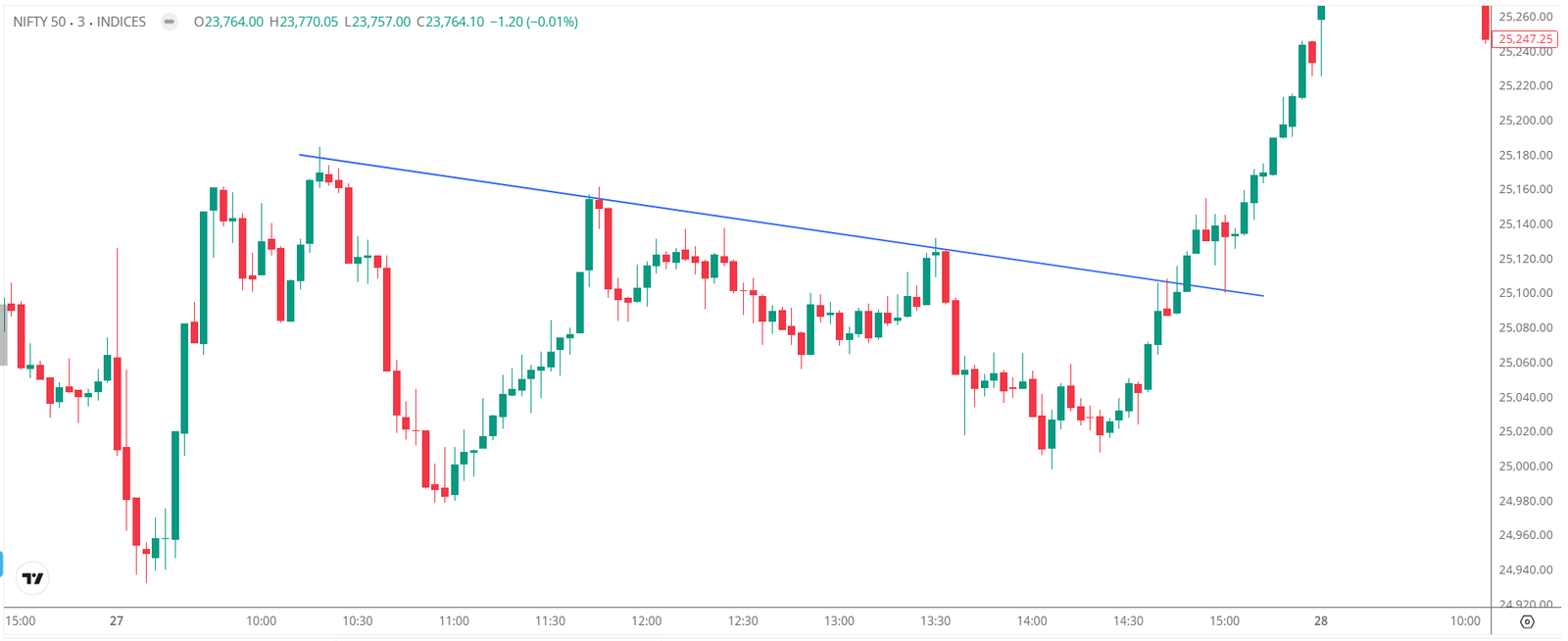
- The Consolidation: The Nifty must spend the entire afternoon (12:00 PM to 2:00 PM) trading in a very tight, boring range just below that round number.
- The High OI: Open your Option Chain. If you see a massive mountain of Call (CE) Open Interest at that round number, you have your trap set. Those option sellers are feeling safe.
The Execution (The 2:15 PM Rule)
If you blindly buy ₹5 options at 1:00 PM, Theta (time decay) will melt them to ₹1 before the breakout even happens. Timing is everything.
- Wait for the Break: Sometime between 2:15 PM and 2:45 PM, if the Nifty violently breaks above that round number, the Call sellers will panic.
- The Strike Selection: Buy the Call option that is just exactly At-The-Money or one strike OTM. Do not buy strikes that are 200 points away; they will not move.
- The Target: Do not be greedy. When a ₹10 premium spikes to ₹30 or ₹40 due to short covering, book your profits immediately. Gamma works in both directions; a 10-point Nifty pullback will instantly crush that premium back to ₹10.
The Ironclad Risk Management Rule
Zero to Hero trades are highly asymmetric. You can make 500%, but you will lose 100% on most attempts.
Therefore, never risk more than 1% to 2% of your total trading capital on an expiry day hero trade. If your account has ₹1,00,000, you only use ₹1,000 for this trade. If it goes to zero, you won’t even feel it. If it blasts to ₹5,000, it’s a great bonus to your week. Treat it like a highly calculated dart throw, not the core foundation of your trading business.