
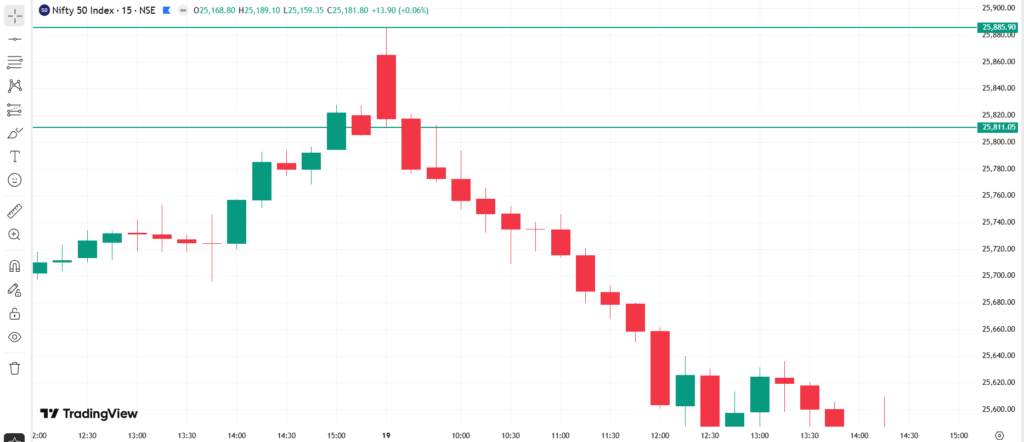
Mastering the Opening Range Breakout (ORB) Strategy for Nifty 50 Options
If you have ever stared at a Nifty 50 chart at 9:15 AM, you know exactly how chaotic the first few minutes of the Indian stock market can be. Premiums spike, candles swing wildly, and retail traders often get trapped buying Calls (CE) or Puts (PE) based on pure emotion.
But what if you could block out that morning noise and trade with a strict, rule-based system?
That is exactly what the Opening Range Breakout (ORB) strategy is designed to do. It is one of the most popular and effective systems for intraday options buyers because it capitalizes on the massive institutional volume that hits the market right after the opening bell.
Here is a deep dive into what the ORB strategy is, why it works on the Nifty, and how to execute it systematically.
What is the Opening Range Breakout?
Simply put, the ORB strategy involves waiting for the market to establish a “range” during a specific time frame immediately after the market opens. Once that time frame is over, you mark the highest price and the lowest price of that period.
When the price breaks out of that range (either above the high or below the low), you take a trade in the direction of the breakout.
The logic is simple: The morning range represents a battle between the bulls and the bears. A breakout indicates that one side has won the fight and institutional momentum is pushing the market in that direction.
How to Trade the ORB on Nifty Options
While some traders use the 5-minute or 30-minute range, the 15-minute ORB is the absolute sweet spot for Nifty 50 intraday trading. It gives the market enough time to digest overnight news but gets you in early enough to catch the main trend of the day.
Here is the step-by-step execution:
Step 1: Let the First 15 Minutes Pass
From 9:15 AM to 9:30 AM, do absolutely nothing. Sit on your hands. Let the initial volatility settle and let the 15-minute candle fully close.
Step 2: Mark the High and Low
Once the clock strikes 9:30 AM, draw a horizontal line at the highest point and the lowest point of that 15-minute candle. This is your “Opening Range.”
Step 3: Wait for the Breakout
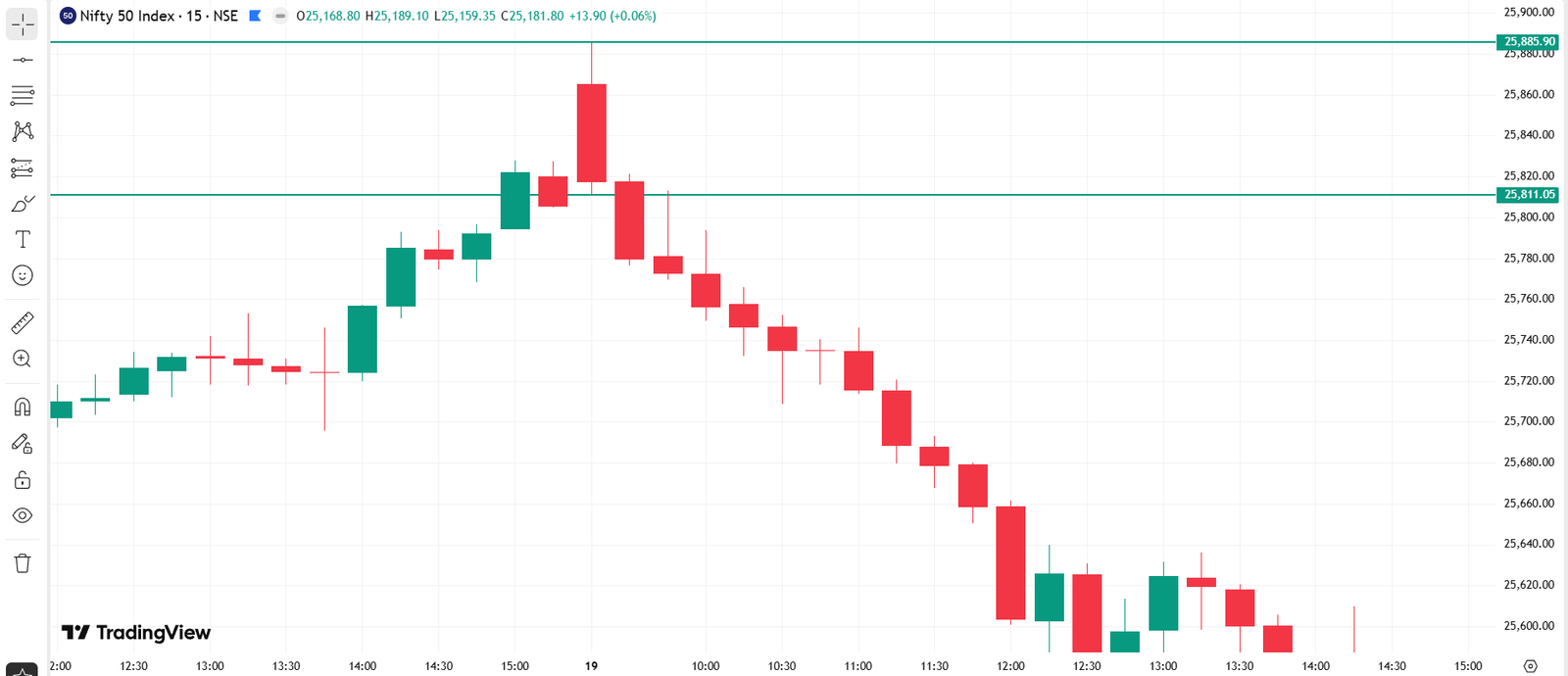
Now, you watch the subsequent 5-minute candles.
- The Call (CE) Entry: If a 5-minute candle closes above your Opening Range High, you buy an At-The-Money (ATM) or slightly Out-of-The-Money (OTM) Call Option.
- The Put (PE) Entry: If a 5-minute candle closes below your Opening Range Low, you buy a Put Option.
Step 4: Strict Stop Loss and Targets
As an options buyer, premium decay (Theta) is your biggest enemy. You cannot afford to hold a losing trade.
- Stop Loss: A standard stop loss is the opposite end of the breakout candle, or ideally, the midpoint of the original 15-minute opening range. If the price falls back into the range, the breakout has failed, and you must exit immediately.
- Target: Aim for a 1:1.5 or 1:2 Risk-to-Reward ratio.
The Reality Check: Fake Breakouts (Whipsaws)
I want to be completely honest with you: No strategy has a 100% win rate.
The biggest challenge with the ORB strategy is the “whipsaw” or fake breakout. This happens when the Nifty breaks the 15-minute high, triggers your CE buy order, and instantly reverses to hit your stop loss.
How do we fix this? By adding confluence. You should never trade ORB blindly. Successful systematic traders use additional filters:
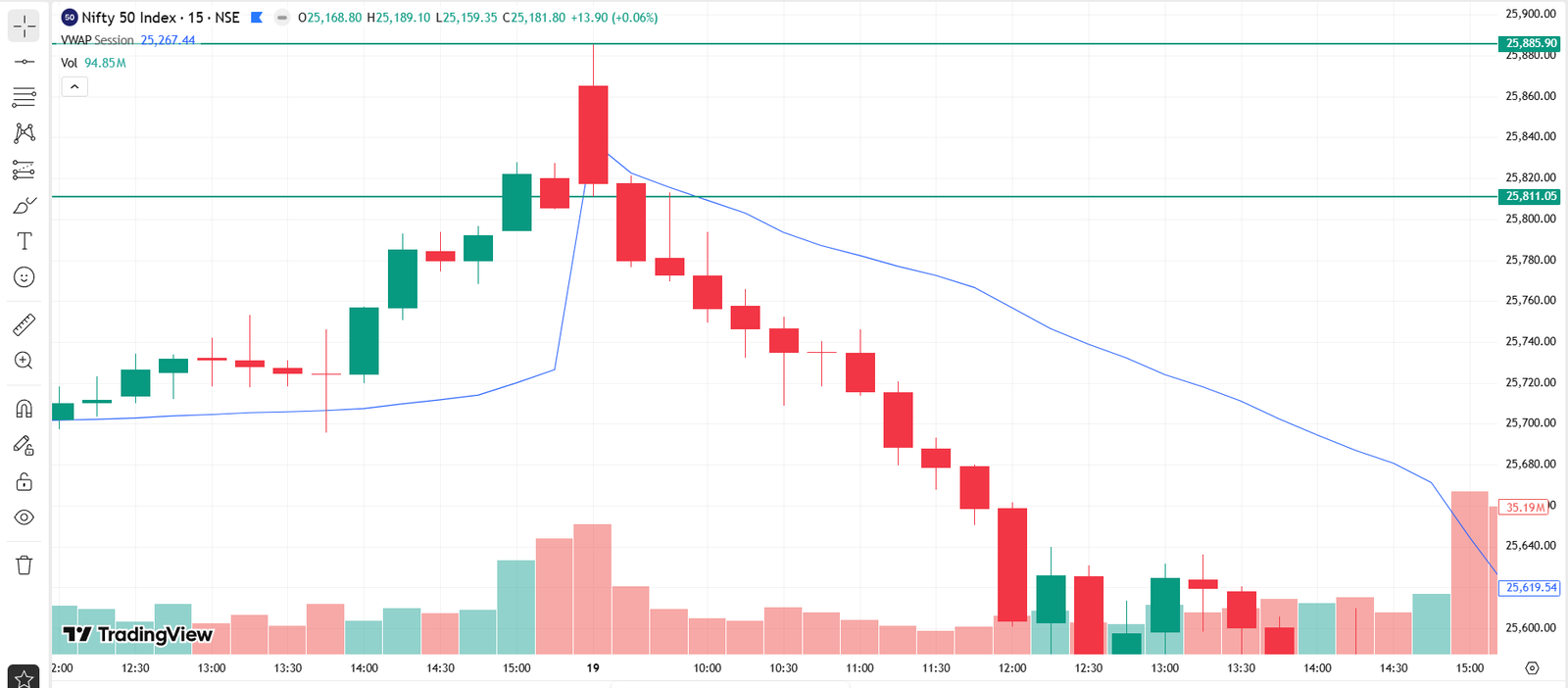
- Volume: Does the breakout candle have higher volume than the previous candles?
- VWAP: Is the price breaking out above the Volume Weighted Average Price (VWAP) line?
- Prior Day High/Low: Is the breakout happening near a major resistance level from yesterday?
Why Backtesting is Non-Negotiable
If you are serious about generating active income from the stock market, you cannot just guess. The only way to trust the ORB strategy is to backtest it against months or years of historical Nifty options data.
You need to know your exact win rate and maximum drawdown before you risk real capital across your broker accounts. Find a robust charting and backtesting tool, run the data, and let the math dictate your trades, not your emotions.