
The Math of Wealth: Why Risk-to-Reward Matters More Than Your Win Rate
If you walk into any high-level finance firm or investment bank, you will notice something surprising. The top traders running multi-crore portfolios do not have a 90% win rate. In fact, many of the best trend-followers in the world only win about 40% of their trades.
How can a professional in the financial markets lose 60% of the time and still generate massive wealth?
The secret is not a magical indicator. It is cold, hard mathematics. It is the mastery of the Risk-to-Reward (R:R) Ratio. If you are tired of blowing up your Nifty options account after one bad day, you need to stop obsessing over your win rate and start treating your trading like an insurance business.
The “Insurance Company” Mindset
Think about how a major insurance company operates. They know that out of every 1,000 policies they write, a few people will have a massive car crash and file a huge claim. The insurance company expects to take losses.
But they remain highly profitable because the math is heavily tilted in their favor. The premiums they collect far outweigh the occasional payouts.
As a retail options buyer, you must flip this model to your advantage. Every time you enter a Bank Nifty trade, you are paying a small “premium” (your stop loss). You accept that you will frequently lose that small premium. But when the market actually breaks out, your “claim payout” (your reward) must be massive.
The 1:2 Minimum Rule
If you risk ₹1,000 on a trade, your absolute minimum target must be ₹2,000. This is a 1:2 Risk-to-Reward ratio.
Let’s look at the brutal math of why this is the only way to survive: Imagine you take 10 trades this week. You are having a terrible week, and you lose 6 out of 10 trades (a 40% win rate).
- Your 6 Losses: You lose ₹1,000 on each. Total Loss = ₹6,000.
- Your 4 Wins: You make ₹2,000 on each. Total Profit = ₹8,000.
- Net Result: Even after losing more than half the time, you end the week with a ₹2,000 net profit.
If you trade with a 1:1 ratio (risking ₹1,000 to make ₹1,000), that same 40% win rate would leave you with a ₹2,000 loss.
The Trap of the “Quick Scalp”
Many beginners trade with a negative R:R. They buy a Nifty Call option, panic when it drops ₹20 (holding the loss hoping it bounces), but the second it goes into a ₹10 profit, they exit immediately to secure a “green screen.”
They are risking ₹20 to make ₹10. To survive with this math, you need an impossible 80% win rate. One bad gap-down or sudden institutional sell-off will wipe out two weeks of hard work.
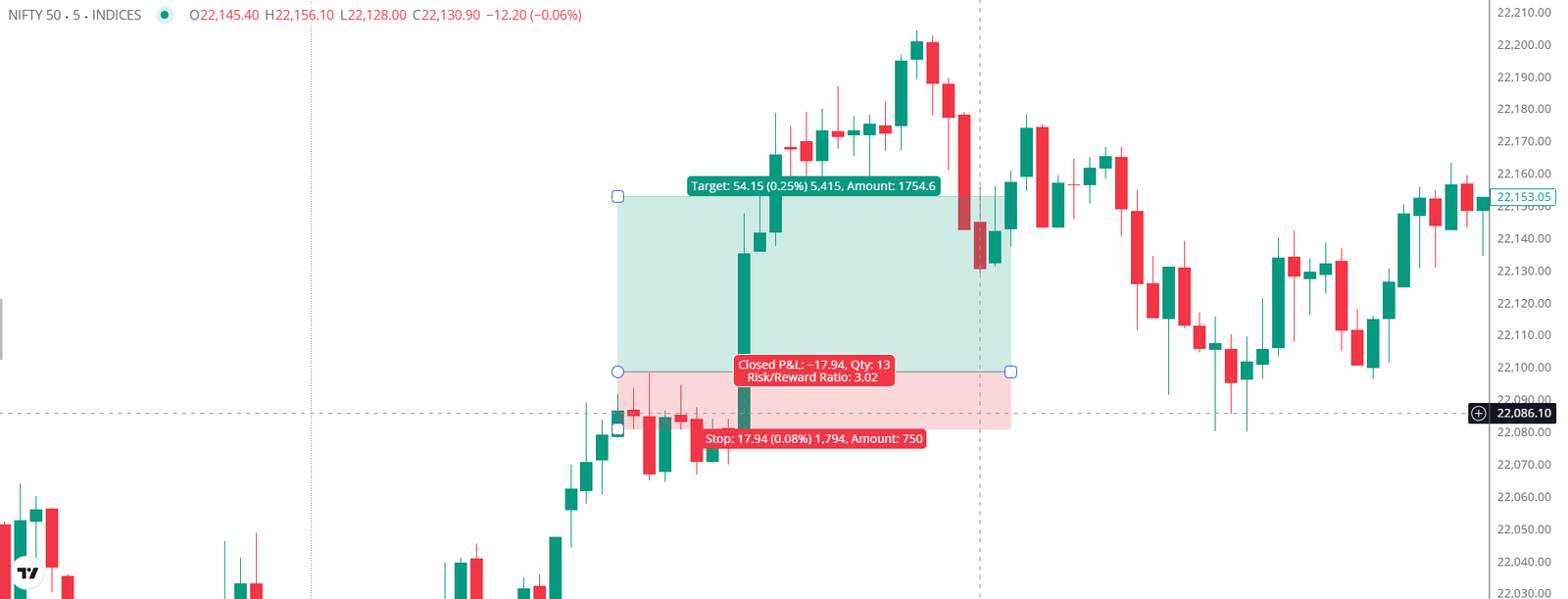
How to Fix Your Execution
- Never adjust your stop loss down. If your credit or capital limit dictates a 15-point stop on the option premium, place it in the system and accept the loss if it hits.
- Trail your winners. If the market is running, do not click exit. Move your stop loss to your entry price, securing your capital, and let the institutional momentum carry your trade to a 1:3 or 1:4 reward.
Stop trying to be right every time. Start focusing on making the most money possible when you are right.