
Options Buying vs. Options Selling: The Brutal Truth for Retail Traders
If you spend five minutes on Indian financial social media, you will see a massive war going on. On one side, you have the aggressive Options Buyers posting screenshots of 500% intraday returns. On the other side, you have the calm Options Sellers (Writers) claiming that buyers are just gamblers and that selling is the only way to generate consistent wealth.
If you are a retail trader trying to figure out where to park your capital, this debate is exhausting. The truth is, neither side is 100% right, and both sides are hiding their biggest flaws.
Here is the unfiltered, mathematical reality of Options Buying versus Options Selling, and how to decide which one actually fits your account size and psychology.
The Allure of Options Buying
Options buying (purchasing Calls or Puts) is how 90% of retail traders enter the market.
- The Pros: It requires very low capital. You can buy a Nifty At-The-Money (ATM) option for just ₹5,000. Your maximum risk is strictly limited to the premium you paid, but your profit potential is theoretically unlimited. If a massive Gamma blast happens on expiry day, your ₹5,000 can become ₹25,000 in an hour.
- The Brutal Con: Time is your absolute worst enemy. Because of Theta (time decay), the mathematical probability of a naked option buyer making money is only around 33%. You need the market to move in your direction, and you need it to move fast. If the Nifty just goes sideways for three hours, you lose money.
The Reality of Options Selling (Writing)
Options selling is the domain of institutional money and high-net-worth individuals. Instead of paying a premium, they collect it.
- The Pros: The math is heavily in your favor. An option seller wins if the market goes their way, or if the market just stays completely sideways. Theta decay puts money into their account every single minute. They have a massive 66% probability of winning the trade.
- The Brutal Con: The margin requirements are massive. To sell one lot of Nifty options, your broker will require roughly ₹1,00,000 to ₹1,20,000 in margin. Furthermore, naked option selling carries theoretically unlimited risk. If you sell a Call option and a sudden overnight news event causes the Nifty to gap up 300 points, your account can be completely wiped out in a single second.
The Retail Dilemma: The Capital Trap
Most retail traders know that option selling has a higher win rate, but they are trapped by their account size. If you only have ₹50,000 in trading capital, you physically cannot be a naked option seller. Your broker won’t allow it.
This forces beginners into options buying, where they slowly bleed their small accounts to death via time decay because they don’t know how to catch fast momentum.
The Professional Compromise: Credit and Debit Spreads
If you want to trade like a professional, you have to stop treating buying and selling like two different religions. You must combine them to create Spreads.
If you only have ₹50,000 but want the mathematical advantage of an option seller, you don’t have to trade naked.
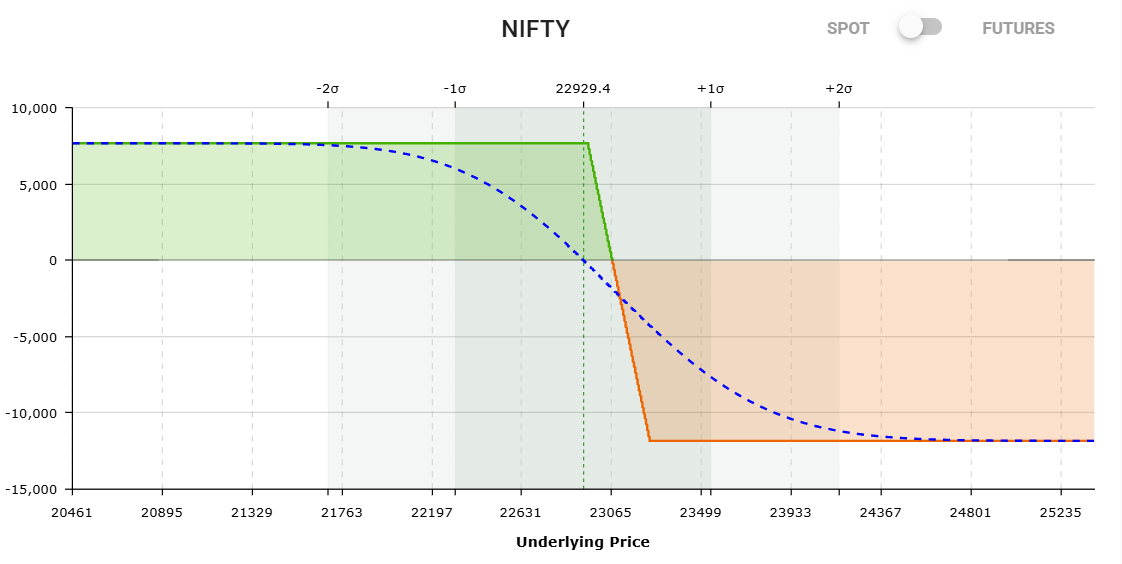
- The Fix: If you think the market will stay below 22500, you can sell the 22500 Call, and instantly buy the 22700 Call as insurance.
- Because you bought the insurance leg, your broker caps your maximum risk. Suddenly, that ₹1,20,000 margin requirement drops to just ₹30,000 or ₹40,000.
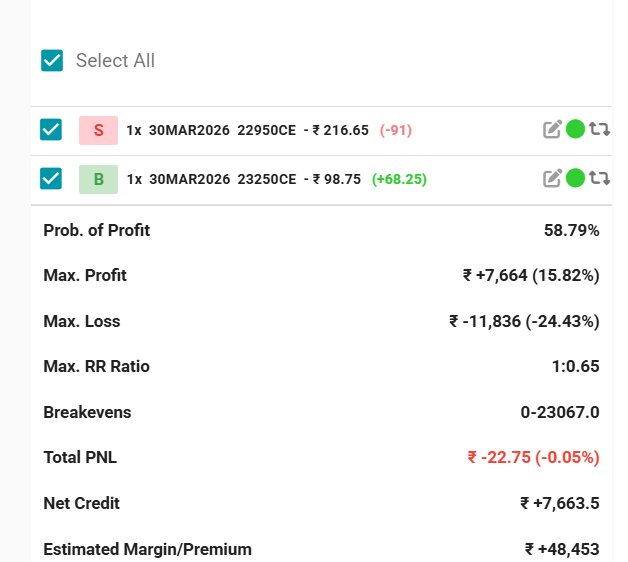
You get to collect the premium, time decay works in your favor, and you are completely protected from a Black Swan market crash.
Stop fighting over which method is better. Understand the Greeks, respect your capital limits, and use hedged spreads to survive the institutional chop.