
Delta Hedging Mechanics: How Institutions Neutralize Directional Risk in Real Time
If you ask a retail trader what their trading strategy is, they will usually give you a directional answer: “I buy when the market goes up, and I short when the market goes down.” Retail traders are entirely dependent on predicting the future direction of the price.
But if you walk onto the trading floor of a major banking institution or a quantitative hedge fund, you will find a completely different reality. The massive players in the world of high-level finance do not like to guess directions. Predicting the future is a gamble, and institutions do not gamble with billions in capital.
Instead, they act like an insurance company. They want to collect the premium (via options selling) while completely eliminating the risk of the market moving against them. How do they magically erase directional risk? They use a mathematical execution strategy called Delta Hedging.
If you want to understand why the market sometimes accelerates violently out of nowhere, you need to understand how algorithmic Delta Hedging works.
The Directional Problem
Let’s look at the risk an institutional option seller takes.
Assume a major investment firm sells 10,000 Out-Of-The-Money Call options. By selling these Calls, they receive a massive inflow of premium (cash) into their account. Their goal is simple: let the time decay (Theta) melt those options to zero and keep 100% of the cash.
But there is a massive threat. If a surprise news event occurs and the underlying market violently breaks out to the upside, those 10,000 Call options will explode in value. The institution is caught on the wrong side of the trade and faces theoretically unlimited losses.
They cannot just close the trade, because the spread and liquidity costs on 10,000 contracts are too high. They need a shield.
The Mathematical Shield: Becoming “Delta Neutral”
To protect their credit and capital, the institution looks at the Delta of the options they just sold.
If you sell a Call option, you have a negative Delta. Let’s say their entire position of 10,000 sold Calls gives them a net Delta of -50,000. This means for every 1 point the market goes up, the institution loses 50,000 points of capital.
To neutralize this, they go directly into the cash or futures market and buy exactly 50,000 units of the underlying asset.
- The underlying asset always has a Delta of exactly +1.
- By buying 50,000 units, they generate a positive Delta of +50,000.
The Math: (-50,000 Option Delta) + (+50,000 Asset Delta) = 0 Net Delta.
This is called being Delta Neutral. Now, if the market crashes, they lose money on the asset but make it all back on the sold Calls. If the market skyrockets, they lose money on the Calls but make it all back on the asset. Direction no longer matters. They are perfectly hedged, and they can quietly sit back and collect the Theta time decay.
The Real-Time Nightmare: Dynamic Hedging
If Delta stayed the same all day, institutional trading would be easy. But Delta is constantly moving.
Because of another Greek called Gamma, an option’s Delta changes every single time the market price moves. If the underlying market rallies aggressively, the Delta of those sold Call options becomes more negative. Suddenly, the institution’s portfolio is no longer at 0 Net Delta; it has slipped to -10,000. They are exposed to risk again.
To fix this, the institution’s automated algorithms must instantly jump into the market and buy another 10,000 units of the underlying asset to get the portfolio back to zero.
This process is called Dynamic Delta Hedging. It requires algorithms to constantly buy and sell the underlying asset in real-time, all day long, just to keep their risk perfectly balanced.
How Retail Traders Can Exploit the Hedge
Why does this institutional math matter to a retail options buyer? Because Dynamic Hedging is the secret fuel behind massive, violent breakouts.
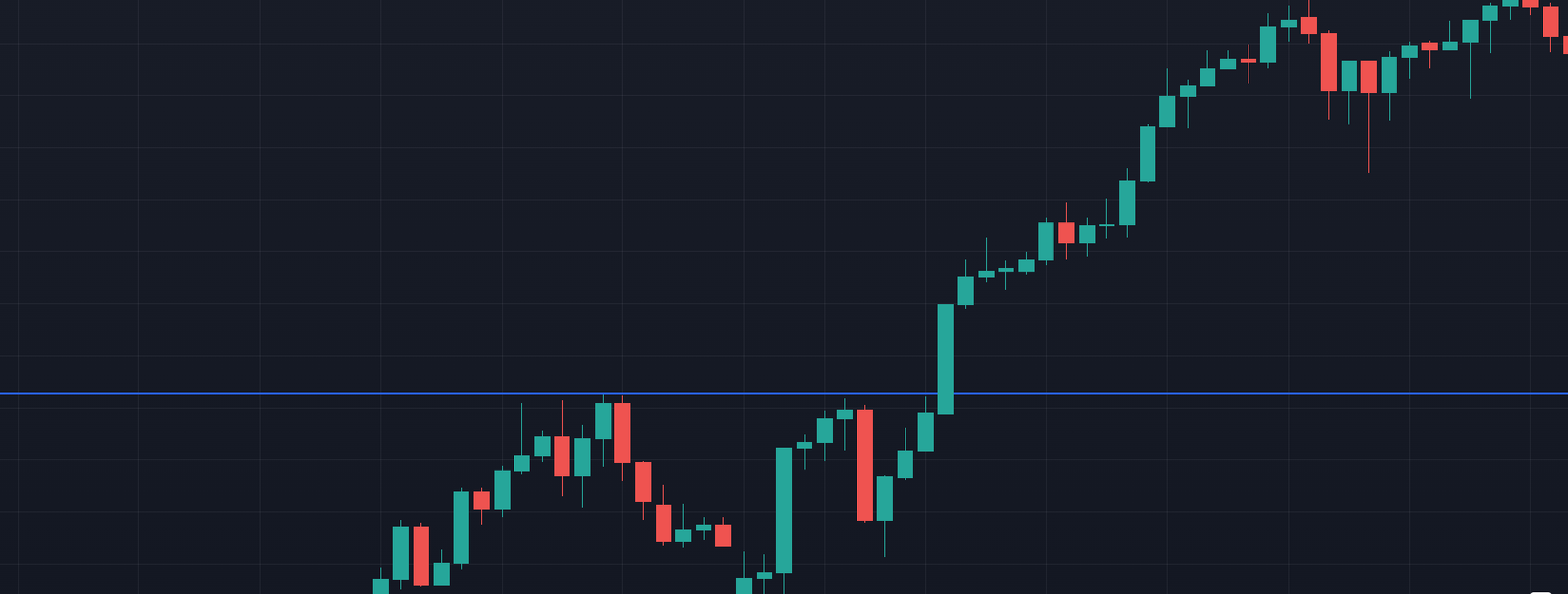
Imagine the market approaches a major, multi-month resistance line.
- Retail traders start buying the breakout.
- As the price goes up, the institutions who sold massive amounts of Call options see their Delta becoming highly negative.
- Their risk-management algorithms automatically trigger aggressive Market Buy orders for the underlying asset to hedge the risk.
- This massive influx of institutional buying pushes the market even higher!
- This forces more Delta hedging, which forces more buying.
This mechanical loop is called a Gamma Squeeze. It is not driven by fundamental news; it is driven entirely by computers desperately trying to stay Delta Neutral.
Stop trying to predict what the news will do to the market. Start looking at where the massive options volume is concentrated, understand that institutions must mathematically hedge those positions, and ride the mechanical wave when the algorithms are forced to buy.