
Pair Trading Insights: How Hedge Funds Profit from Relative Mispricing
If you spend enough time in the financial markets, you will eventually realize a harsh truth: predicting the absolute direction of the market is incredibly difficult, and for many retail traders, it is a mathematically losing game. You can analyze a chart for hours, read every fundamental report, and buy a breakout perfectly. But overnight, a sudden geopolitical crisis or an unexpected macroeconomic shock can cause the entire broader market to gap down violently, destroying your trade and wiping out your capital.
You did nothing wrong with your technical analysis. You simply fell victim to “Market Risk” (also known as Beta). If the entire ocean drops, every boat drops with it, no matter how well-built your specific boat is.
But what if there was a way to trade where it simply did not matter if the overall market crashed or skyrocketed? What if you could build a portfolio where the general direction of the benchmark index was completely irrelevant to your profitability?
If you walk into the proprietary trading desks of major banking institutions or quantitative hedge funds, this is exactly how they operate. They do not lose sleep worrying about overnight market crashes. They protect their investment capital by utilizing advanced, market-neutral strategies. The most famous, reliable, and heavily utilized of these strategies is known as Pair Trading.
By mastering the mechanics of relative mispricing, you can stop fighting the chaotic swings of the broader market and start generating consistent returns based on pure, mathematical convergence.
The Illusion of Directional Trading
Before we dive into the mechanics of Pair Trading, we must deconstruct why traditional directional trading is so dangerous for your capital.
When you buy a single stock, you are exposed to two entirely different types of risk:
- Idiosyncratic Risk: This is the risk specific to the company itself. For example, if you buy shares in a massive insurance provider and their CEO unexpectedly resigns in a scandal, the stock will crash. This is a risk tied directly to that one company.
- Systemic Risk (Market Risk): This is the risk of the entire financial system. If global central banks unexpectedly raise interest rates, the entire equity market will sell off. Even if your chosen company just reported record profits, its stock price will be dragged down by the sheer weight of the macroeconomic panic.
Retail traders are usually completely unprotected from Systemic Risk. When a major crash happens, they just watch their screens bleed red. Hedge funds, however, use Pair Trading to completely neutralize this Systemic Risk. They build a wall around their trades so that global panic cannot touch them.
The Core Concept: What is Pair Trading?
Pair Trading is a market-neutral strategy that involves matching a long position in one asset with a simultaneous short position in another highly correlated asset.
Instead of betting that “Stock A will go up,” you are betting that “Stock A will perform better than Stock B.”
Imagine two massive companies in the finance sector. Let’s call them Bank A and Bank B. Because they operate in the exact same economic environment, deal with the exact same interest rates, and lend to the exact same consumer base, their stock prices usually move together. If the banking sector has a great month, both stocks go up. If the sector faces a crisis, both stocks go down.
They are tethered together by underlying economic realities. Think of them as two dogs being walked on the same leash.
Sometimes, one dog might pull a little bit ahead, and the other might lag behind to sniff a tree. But eventually, the tension on the leash reaches its maximum limit, and the dogs are forced to snap back together and walk side-by-side.
In the financial markets, this “snapping back together” is called Mean Reversion.
If Bank A suddenly skyrockets due to irrational retail hype, while Bank B stays flat, the historical relationship between the two stocks is broken. The “leash” is stretched to its absolute maximum. A pair trader will look at this anomaly and execute two trades simultaneously:
- Short the overvalued stock (Bank A).
- Buy (Long) the undervalued stock (Bank B).
Now, what happens if the entire stock market suddenly crashes the next day? Bank B (your long position) will lose money. But Bank A (your short position) will also crash, generating a massive profit that cancels out the loss. What happens if the entire market violently rallies? Bank A (your short position) will lose money, but Bank B (your long position) will rally, canceling out the loss.
You are completely insulated from the market’s direction. Your only goal is for the gap between Bank A and Bank B to close. Once the two stocks return to their historical average distance from each other, you close both positions and pocket the difference.
Co-integration vs. Correlation: The Secret Mathematical Filter
The biggest mistake amateur traders make when attempting to pair trade is relying purely on “Correlation.”
Correlation simply means two assets tend to move in the same direction. But high correlation is not enough. For a true, institutional-grade pair trade, the two assets must be Co-integrated.
Co-integration means that the spread (the price difference) between the two assets is “stationary.” It means that over a long period of time, the distance between the two stocks always reverts back to a reliable, flat average.
For example, two technology companies might be highly correlated (they both go up over a five-year period). But if Company A grows 50% every year and Company B only grows 10% every year, the gap between them will continue to widen infinitely. They will never revert to a mean. If you try to pair trade them, the rubber band will just snap, and you will lose your capital.
To find co-integrated pairs, professional traders look for companies with identical business models. The banking, telecommunications, and insurance sectors are the absolute best hunting grounds for this strategy because the companies are essentially identical commodities separated only by their brand names.
Building the Technical Setup: The Ratio Chart
To execute this strategy, you cannot just look at two separate price charts side-by-side. You have to combine them into a single, highly readable mathematical chart.
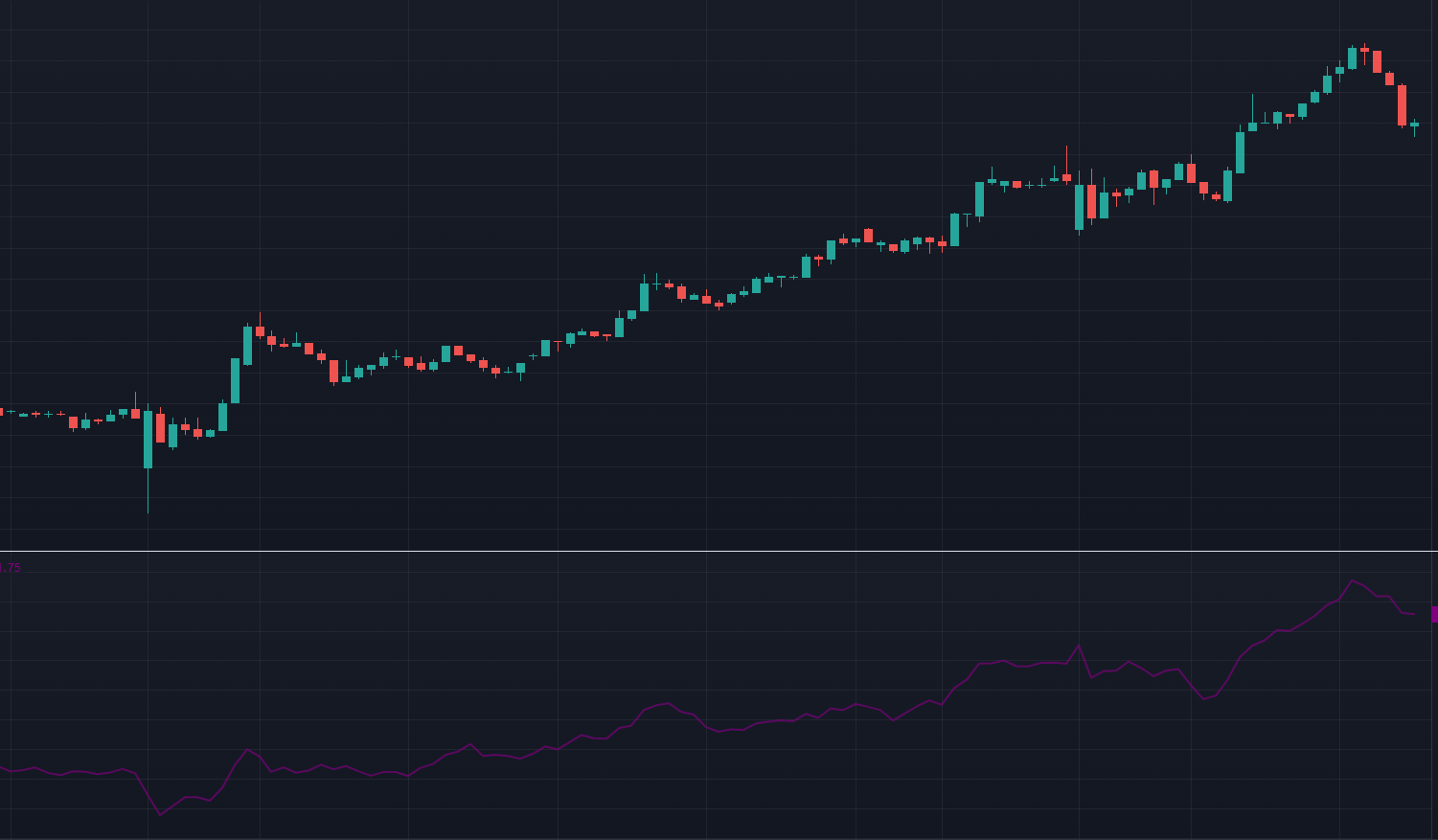
Most advanced trading platforms (like TradingView) allow you to create a Ratio Chart. Instead of typing in the ticker symbol for a single stock, you type in a mathematical formula: (Ticker A / Ticker B).
This creates a brand-new candlestick chart that represents the ongoing relationship between the two assets.
- If the Ratio Chart is going up, it means Ticker A is outperforming Ticker B.
- If the Ratio Chart is going down, it means Ticker B is outperforming Ticker A.
- If the Ratio Chart is moving perfectly sideways, the two assets are performing identically.
For a co-integrated pair, this Ratio Chart will look like a perfect, sideways sine wave. It will oscillate up and down, constantly crossing back over its middle average line.
The Ultimate Indicator Combo: Bollinger Bands on the Spread
Now that you have your Ratio Chart, you need a mechanical system to tell you exactly when the rubber band is stretched too far. You need an indicator to define the absolute extreme limits of the historical relationship.
The ultimate tool for this is the Bollinger Band.
When you apply a Bollinger Band to your Ratio Chart, you are wrapping the historical spread in a mathematical volatility envelope based on Standard Deviation.
Here is the professional setup:
- Open your Ratio Chart.
- Apply a standard Bollinger Band indicator.
- Set the Moving Average (the middle line) to a 20-period SMA.
- Set the Standard Deviation (the outer bands) to 2.0 or 2.5.
The middle line now represents the historical “fair value” relationship between the two stocks. The upper and lower bands represent the extremes. Statistically, price action will stay inside a 2.0 Standard Deviation band roughly 95% of the time.
If the candlesticks on your Ratio Chart violently pierce the Upper Bollinger Band, you have a mathematical anomaly. Ticker A has become drastically overvalued compared to Ticker B. The market is acting irrationally.
The Entry Trigger: RSI Divergence on the Spread
You never want to step in front of a moving freight train. Even if the Ratio Chart hits the Upper Bollinger Band, sheer momentum can carry it further into irrational territory, dragging your account into a drawdown.
You need a secondary confirmation indicator to prove that the momentum of the anomaly has died. You need the Relative Strength Index (RSI).
Apply a standard 14-period RSI to the bottom of your Ratio Chart. You are looking for a Divergence.
- The Ratio Chart hits the Upper Bollinger Band and pulls back slightly.
- It then pushes up again, making a “Higher High” on the price chart, pushing even deeper outside the Bollinger Band.
- However, when you look down at your RSI, the indicator prints a “Lower High.”
This divergence is your ultimate trigger. It proves that the irrational momentum stretching the two stocks apart has officially exhausted itself. The rubber band is ready to snap back.
The Execution Mechanics: Balancing the Legs
When your setup triggers, you must enter the market. Let’s assume your Ratio Chart (Bank A / Bank B) has hit the Upper Bollinger Band with RSI divergence. This means Bank A is dangerously overvalued, and Bank B is undervalued.
You must simultaneously:
- Sell Short Bank A.
- Buy Long Bank B.
However, you cannot just buy 100 shares of A and 100 shares of B. If Bank A trades at 500 per share and Bank B trades at 100 per share, buying equal quantities will result in a severely unbalanced portfolio. Your risk will be skewed heavily toward the more expensive stock.
To execute a true market-neutral pair trade, your positions must be Cash Neutral. If you allocate 100,000 in capital to this trade, you must short exactly 50,000 worth of Bank A, and buy exactly 50,000 worth of Bank B.
By balancing the absolute cash value of both legs, you ensure that a 1% move in the broader market affects both sides of your trade equally, rendering the overall market direction mathematically irrelevant to your net profit.
Furthermore, many institutional brokers recognize the hedged nature of this strategy. Because you are perfectly market-neutral, brokers will often require significantly less margin, expanding your available line of credit and allowing you to utilize your capital with maximum efficiency.
Strict Risk Management: The Fixed Point Parameter Rule
While pair trading eliminates systemic market risk, it does not eliminate the risk of a fundamental structural shift in the companies themselves. Sometimes, a stock becomes overvalued because of a massive, unannounced merger or a revolutionary change in their business model. If this happens, the spread will never revert to the mean—it will just keep expanding.
Therefore, you must have an ironclad risk management system in place.
Many amateur traders try to manage pair trades using vague percentage-based drawdowns on their total account equity. This is a messy, emotional way to manage a highly mathematical setup. To trade like an institution, you must manage your risk based on the actual geometry of the spread chart itself.
To completely remove emotion from the equation, you must abandon percentage-based risk parameters in favor of strict, predefined fixed point limits calculated directly from the spread’s point differential.
Before you enter the trade, calculate the exact point distance of your expected mean reversion. For optimal execution, establish a strict 400-point target and a hard 200-point stop loss on the spread differential.
- The 400-Point Target: Your take-profit is not based on how much cash you want to make. It is based on the spread returning to the 20-period SMA on the Bollinger Band. You calculate the point difference between your entry at the upper band and the middle SMA line. If that distance is roughly 400 points of spread compression, that is your automated exit.
- The 200-Point Stop Loss: If the spread continues to widen against you by a fixed 200 points beyond your entry, the co-integration is officially considered broken. You do not hold the position hoping for a miracle. You do not check the news to see if the market will turn around. You immediately close both legs of the trade.
By utilizing a hard 400-point target and a 200-point stop loss, you are forcing your strategy into a perfect 1:2 Risk-to-Reward ratio. You can be wrong 50% of the time and still generate massive, compounding wealth because your mathematical parameters are dictating your survival, not your gut feeling.
Conclusion: Trading Like the House
Directional trading is a high-stress, high-anxiety endeavor. It forces you to constantly consume news, guess global macroeconomic policies, and live in fear of overnight gap-downs.
Pair trading allows you to step out of the casino and start operating like the house. By locating highly co-integrated assets within the same sector, plotting them on a Ratio Chart, and wrapping them in volatility indicators like Bollinger Bands, you isolate the only thing that actually matters: mathematical mispricing.
You no longer care if the broader financial system is booming or collapsing. You only care about the space between the lines. Build your charts, calculate your fixed point targets, balance your cash legs perfectly, and let the undeniable laws of mean reversion do the heavy lifting for your portfolio.