
Kelly Criterion Revisited: The Math Behind Optimal Position Sizing
If you spend enough time navigating the complex world of the financial markets, you will inevitably go through the standard evolution of a trader. During your first year, you obsess over finding the perfect entry signal. You clutter your screens with a dozen different moving averages, momentum oscillators, and volume profile tools. You believe that if you can just predict the exact moment an asset will reverse, you will achieve ultimate financial freedom.
But as the years pass, and you review your trading journals, a deeply frustrating reality begins to set in. You realize that your technical analysis is actually quite good. You are correctly predicting the direction of the market more often than not. Yet, despite having a reliable technical edge, your trading account is either stagnant or slowly bleeding out.
How is it possible to be right about the market direction, but still lose money?
The answer lies in the single most neglected, misunderstood, and poorly executed aspect of active trading: Position Sizing.
Amateur traders view position sizing as an afterthought. They look at their available account margin and simply buy as many contracts or shares as the broker allows. Professional traders operating within the massive proprietary desks of global banking institutions do the exact opposite. They know that the entry signal is merely a small variable in a much larger equation. The true secret to long-term wealth generation is not knowing when to buy; it is knowing exactly how much to buy.
To bridge the gap between amateur chart reading and professional quantitative execution, we must revisit a mathematical formula developed in 1956 by a researcher at Bell Labs. It is a formula that revolutionized the world of probability, casino blackjack, and modern finance. It is called the Kelly Criterion, and if you want to protect your capital from the chaotic swings of the market, you must make it the absolute core of your trading system.
The Mathematical Illusion of the “Hot Streak”
Before we break down the formula, we must understand the psychological trap that destroys traders who ignore it. This trap is known as “The Gambler’s Ruin.”
Imagine you have developed a highly profitable breakout strategy. You have backtested it rigorously, and it boasts an impressive 60% win rate. You begin trading this system with a total account balance of 100,000.
Because you feel incredibly confident in your 60% win rate, you decide to risk 20% of your total account on every single trade.
Your first trade is a winner. Your account grows. Your second trade is a winner. Your account grows again. You feel like an absolute genius. You are compounding your money at an astronomical rate.
But then, probability steps in. Even with a 60% win rate, mathematics dictates that you will eventually face a losing streak. It is not a possibility; it is a statistical certainty.
You hit a brutal streak of four consecutive losses.
- Trade 1 Loss: You lose 20,000. Account drops to 80,000.
- Trade 2 Loss: You lose 16,000. Account drops to 64,000.
- Trade 3 Loss: You lose 12,800. Account drops to 51,200.
- Trade 4 Loss: You lose 10,240. Account drops to 40,960.
In just four trades, your account has been obliterated by 60%. It will now require a massive 150% return just to get back to your starting balance of 100,000. Your trading psychology is completely broken, you are terrified to pull the trigger on the next setup, and you abandon the strategy entirely.
You had a proven mathematical edge, but your aggressive, arbitrary position sizing destroyed you. You treated the financial markets like a lottery ticket rather than an insurance underwriting business. To survive these inevitable losing streaks, you must stop guessing your position size and let the Kelly Criterion calculate it for you.
Demystifying the Kelly Formula
The Kelly Criterion is a mathematical formula designed to determine the optimal size of a series of bets in order to maximize the logarithm of wealth over time. In simple terms, it calculates exactly what percentage of your total account you should risk on a single trade to achieve the highest possible growth rate without exposing yourself to the risk of total ruin.
The beauty of the Kelly Criterion is that it relies purely on the historical performance data of your specific trading system.
The formula is expressed as:
$K = W – \frac{1 – W}{R}$
Let’s break down these variables into plain, actionable language:
- $K$ (The Kelly Percentage): This is the output. It is the exact percentage of your total account equity that you should risk on your next trade.
- $W$ (Win Probability): This is your historical win rate, expressed as a decimal. If your strategy wins 55 out of 100 trades, your $W$ is 0.55.
- $R$ (Risk-to-Reward Ratio): This is a measure of your average winning trade divided by your average losing trade. If your average winner makes you 400 points, and your average loser costs you 200 points, your $R$ is 2.0.
Let’s plug these numbers into the formula to see how it works in reality.
Assume you have backtested your system. You know your win rate ($W$) is 0.55 (55%). You know your Risk-to-Reward ratio ($R$) is 2.0.
Step 1: Calculate the loss probability $(1 – W)$.
$1 – 0.55 = 0.45$
Step 2: Divide the loss probability by the Risk-to-Reward ratio.
$\frac{0.45}{2.0} = 0.225$
Step 3: Subtract that result from your win probability.
$0.55 – 0.225 = 0.325$
The resulting Kelly Percentage ($K$) is 0.325, or 32.5%.
According to pure mathematics, to achieve the absolute maximum compounding growth for this specific trading strategy, you should risk 32.5% of your total account balance on every single trade.
The Danger of “Full Kelly” and the Necessity of Fractional Sizing
If you just read that last paragraph and felt a sense of terror at the idea of risking 32.5% of your hard-earned capital on a single trade, your instincts are entirely correct.
The raw output of the formula is known as “Full Kelly.” While Full Kelly is mathematically guaranteed to provide the highest possible growth rate over an infinite timeline, it comes with a brutal, hidden caveat: the drawdowns are extraordinarily violent.
If you trade at Full Kelly, you will experience extreme volatility in your equity curve. It is very common for a Full Kelly sizing model to suffer account drawdowns of 50% to 80% along the way. While a computer simulation can easily handle an 80% drawdown and keep executing the system flawlessly, a human being cannot.
If you watch your portfolio drop by 80%, the psychological pain will be unbearable. You will stop trusting your system, you will override your rules, and you will manually close trades out of sheer panic, permanently locking in those catastrophic losses.
Because human psychology is fragile, professional quantitative traders never execute their systems at Full Kelly. Instead, they use a concept called Fractional Kelly.
Fractional Kelly is exactly what it sounds like. You calculate your optimal Kelly percentage, and then you divide it by a set fraction to smooth out the volatility of your equity curve.
The most universally accepted standard in professional finance is “Half Kelly”.
If your optimal Full Kelly output is 32.5%, you divide it by 2. Your actual traded risk becomes 16.25%.
By dropping to Half Kelly, you sacrifice roughly 25% of your theoretical maximum growth rate, but in exchange, you reduce the severity of your drawdowns by nearly 80%. It is the ultimate compromise between aggressive portfolio compounding and psychological preservation. For highly conservative portfolios designed to safeguard long-term investment capital, many funds utilize “Quarter Kelly” or even smaller fractions.
The Flaw of Percentage Risk: Why You Must Use Fixed Points
Now we arrive at the most critical mechanical flaw in how retail traders attempt to apply the Kelly Criterion to their charts.
If you look closely at the Kelly formula ($K = W – \frac{1 – W}{R}$), you will notice that its entire mathematical integrity relies heavily on the $R$ variable (Risk-to-Reward Ratio) being perfectly stable and predictable.
Most amateur traders manage their risk using messy, arbitrary percentages on the chart. They might decide, “I will place my stop loss exactly 2% below my entry candle, and I will place my target exactly 4% above it.”
The problem with this approach is that the actual point distance of the trade fluctuates wildly depending on the price of the asset. On Monday, a 2% drop might mean a 150-point stop loss. By Friday, due to an expansion in market volatility, a 2% drop might represent a 350-point stop loss.
When your stop loss and take profit distances are constantly changing based on percentage math, your $R$ variable is constantly shifting. You are feeding unstable data into the Kelly formula, which means your output will be completely unreliable. You cannot build a professional, systematic edge on shifting foundations.
To utilize the Kelly Criterion flawlessly, you must completely abandon percentage-based risk parameters on your charts. You must replace them with absolute, rigid, fixed point parameters.
This is where the structure of your system must become mechanical. Regardless of the current market price, regardless of the daily volatility, and regardless of what the news is doing, you must lock your risk geometry into place.
For the ultimate stabilization of the Kelly formula, you must adopt a strict, non-negotiable fixed point system: A hard 400-point target, and a hard 200-point stop loss.
Let’s look at why this specific point structure is the holy grail for your math.
If your stop loss is always exactly 200 points from your entry, and your target is always exactly 400 points from your entry, your Risk-to-Reward ratio ($R$) is permanently locked at exactly 2.0. It never fluctuates. It never shifts.
Because your $R$ is permanently frozen at 2.0, your Kelly calculation becomes incredibly stable and deeply reliable.
- The 400-Point Target: This is your absolute exit. When the asset travels 400 points in your favor, the algorithm or your limit order immediately executes. You do not hold the position hoping for 500 points. You do not let greed alter the math. You take the 400 points to satisfy the Kelly formula’s reward parameter.
- The 200-Point Stop Loss: This is your absolute defense mechanism. If the asset moves 200 points against you, the trade is dead. You do not widen the stop because the chart “looks like it might bounce.” You accept the 200-point loss to perfectly satisfy the Kelly formula’s risk parameter.
By forcing the market to adhere to your 400/200 fixed point structure, you transition from being a reactive, emotional trader to a cold, calculating underwriter of risk.
Combining the Math with the Chart
Position sizing math is useless if you do not have a technical edge to trigger the entry. The beauty of this system is that it allows you to pair highly advanced mathematical sizing with incredibly simple, clean charting tools.
You do not need an overly complex chart setup to trade this method. You only need a reliable indicator to confirm the direction of the underlying trend, and let the 400/200 point math handle the rest.
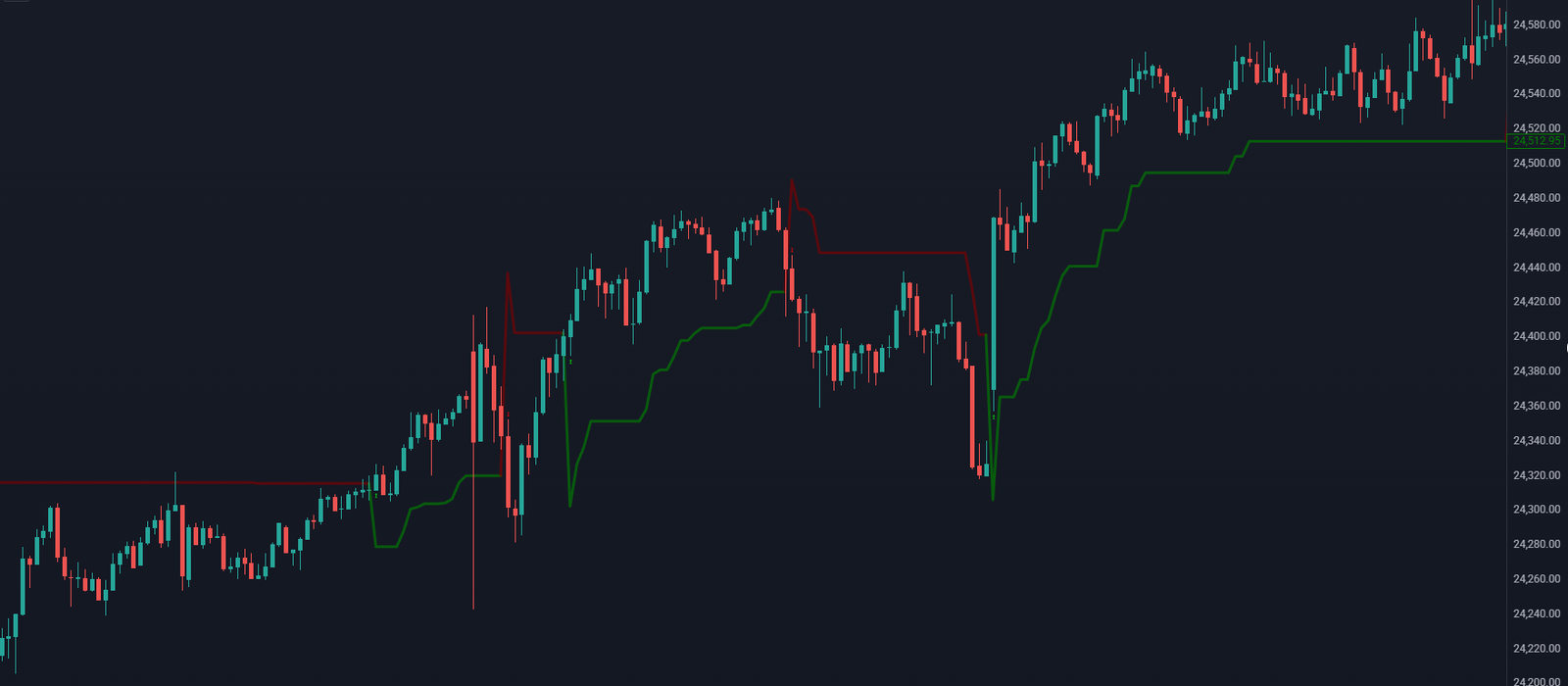
When your chosen indicator signals a valid entry (for example, the price aggressively pulls back to the 50-period EMA and forms a bullish rejection candle), you do not guess your lot size.
- Check your Kelly Fraction: You look at your spreadsheet and confirm that your Half-Kelly risk is, for example, 5% of your total account.
- Calculate the Risk Capital: If your account is 100,000, your allowable risk for this specific trade is exactly 5,000.
- Apply the Fixed Points: You already know your stop loss is a fixed 200 points.
- Determine the Quantity: You divide your Risk Capital (5,000) by your Fixed Point Stop (200). The result is 25. You will buy exactly 25 units of the asset.
By combining a simple visual trend indicator with strict fixed point geometry, you have created a flawless execution loop.
Conclusion
The vast majority of traders will spend their entire careers searching for a magic indicator that never loses. They will jump from strategy to strategy, watching their capital slowly drain away, convinced that the market is rigged against them.
The market is not rigged; it is simply governed by the laws of probability. If you do not understand the math, you will always be the victim of the math.
The Kelly Criterion removes the ego, the fear, and the guesswork from trading. By calculating your historical win rate, locking in a permanent 2.0 Risk-to-Reward ratio using a strict 400-point target and a 200-point stop loss, and applying a Fractional Kelly model to preserve your psychology, you stop playing a guessing game. You align yourself with the exact same quantitative principles used by the most successful algorithmic trading desks on earth.
Build the spreadsheet. Lock in your point parameters. Follow the formula. Protect the capital.