
Bayesian Trading Models: Updating Market Probabilities as New Data Arrives
In the financial markets, you can notice a fatal flaw in how the vast majority of retail participants operate. They are incredibly dogmatic. A retail trader will spend hours over the weekend analyzing a chart, drawing support and resistance lines, looking at moving averages, and constructing a rigid thesis. They will declare, “The market is bullish, and it will bounce at this exact level.”
When Monday morning arrives, and the market opens, they execute their plan. But what happens if, ten minutes into the trading session, massive institutional sell orders flood the tape? What happens if a major geopolitical headline drops, or a sudden credit crisis begins to ripple through the banking sector?
The amateur trader ignores this new information. They cling to their weekend analysis. They watch their position plummet into the red, paralyzed by their initial conviction, shouting at the screen that the market is “wrong.”
The market is never wrong. Your inability to adapt is what destroys your capital.
If you step onto the trading floor of a massive quantitative hedge fund or a proprietary finance firm, you will not find dogmatic beliefs. You will not find analysts defending a broken thesis. Instead, you will find computer models that continuously, ruthlessly, and mathematically change their minds every single millisecond. These institutions do not view the market as a fixed puzzle to be solved; they view it as a living organism of shifting probabilities.
To trade at this elite level, you must abandon rigid predictions and adopt a mathematical framework for changing your mind. This framework is called Bayesian Updating. By understanding how to continuously adjust your market probabilities as new data arrives, you stop fighting the tape and start flowing with the smart money.
The Flaw of Traditional Market Analysis
To understand why Bayesian models are so powerful, we must first look at why traditional technical analysis often fails. Most traders use what is known in statistics as a “Frequentist” approach, even if they do not know the term.
A frequentist looks at historical data and assumes that past frequencies will dictate future outcomes. A trader might backtest a specific chart pattern—like a head and shoulders pattern—and determine that over the last five years, it resulted in a profitable short trade 60% of the time. Therefore, the next time they see this pattern, they blindly assume they have a 60% chance of winning.
This is a static probability. It assumes that the current market environment is perfectly identical to the historical average.
But the stock market is not a static environment. It is highly dynamic. The liquidity conditions of today are different from yesterday. The institutional capital flows are different. If you blindly trade a pattern based on a historical 60% win rate, you are ignoring the immediate reality of the present moment. You are driving a car by only looking in the rearview mirror.
The Core Concept: What is Bayesian Updating?
Bayesian probability is named after Thomas Bayes, an 18th-century statistician. Unlike frequentist statistics, Bayesian logic does not treat probability as a fixed historical fact. Instead, it treats probability as a “degree of belief” that must be constantly updated the moment new evidence is introduced.
Think about how a massive insurance company operates. When they issue a policy, they assign a base probability to the likelihood of an accident based on general demographics. This is their initial belief. However, if that driver subsequently gets two speeding tickets in a single month, the insurance actuaries do not ignore that new data. They instantly feed those tickets into their model and update the driver’s risk profile, raising their premiums. They adjusted their probability based on new evidence.
In trading, Bayesian updating requires you to constantly re-evaluate your trade thesis using a simple, three-part mathematical framework:
- The Prior Probability (The Prior): This is your initial, baseline belief before the market opens or before the trade is taken. It is based on your longer-term technical analysis, historical backtesting, and broader macroeconomic trends.
- The Likelihood (The New Evidence): This is the live, real-time data that is actively occurring right now. It is the immediate price action, the live order flow, a sudden spike in volume, or a breaking news catalyst.
- The Posterior Probability (The Updated Belief): This is the final result. It is your new, updated probability of success after you have mathematically combined your initial belief with the new evidence.
The formal mathematical theorem is expressed as:
$P(A|B) = \frac{P(B|A) \cdot P(A)}{P(B)}$
In the context of the financial markets, this translates to: The probability that my trade setup is valid ($A$), given this sudden new market data ($B$), is equal to the likelihood of seeing this data if my setup was truly valid, multiplied by my initial belief in the setup, divided by the total probability of this new data occurring under any circumstance.
You do not need to calculate this exact formula by hand while day trading. What you need is the mental model. You must train your brain to constantly ask: “Does this new 5-minute candle confirm my prior belief, or does it degrade it?”
Establishing the “Prior” Using Technical Structure
Every Bayesian model must start with a foundation. You cannot update a belief if you do not have an initial belief to begin with. In quantitative trading, we establish our “Prior” by identifying major structural zones on higher timeframe charts.
Let us assume you are looking to invest capital in a major technology stock. You open the Daily timeframe chart. You see that the asset has been in a sustained, multi-month uptrend. Furthermore, the price is currently pulling back perfectly into a major historical support zone that aligns with a widely respected moving average.
Based on your historical backtesting, you know that buying pullbacks to this specific moving average in a bullish trend has a 65% historical win rate.
Your Prior Probability is established: You have a 65% belief that buying this support level will result in a profitable trade.
An amateur trader stops their analysis here. They place a limit order at the moving average and walk away, blindly trusting the 65% historical data. A Bayesian trader, however, knows that 65% is merely the starting line. Now, they must wait for the market to open and observe the new evidence.
Introducing the “New Evidence”: Momentum and Volume
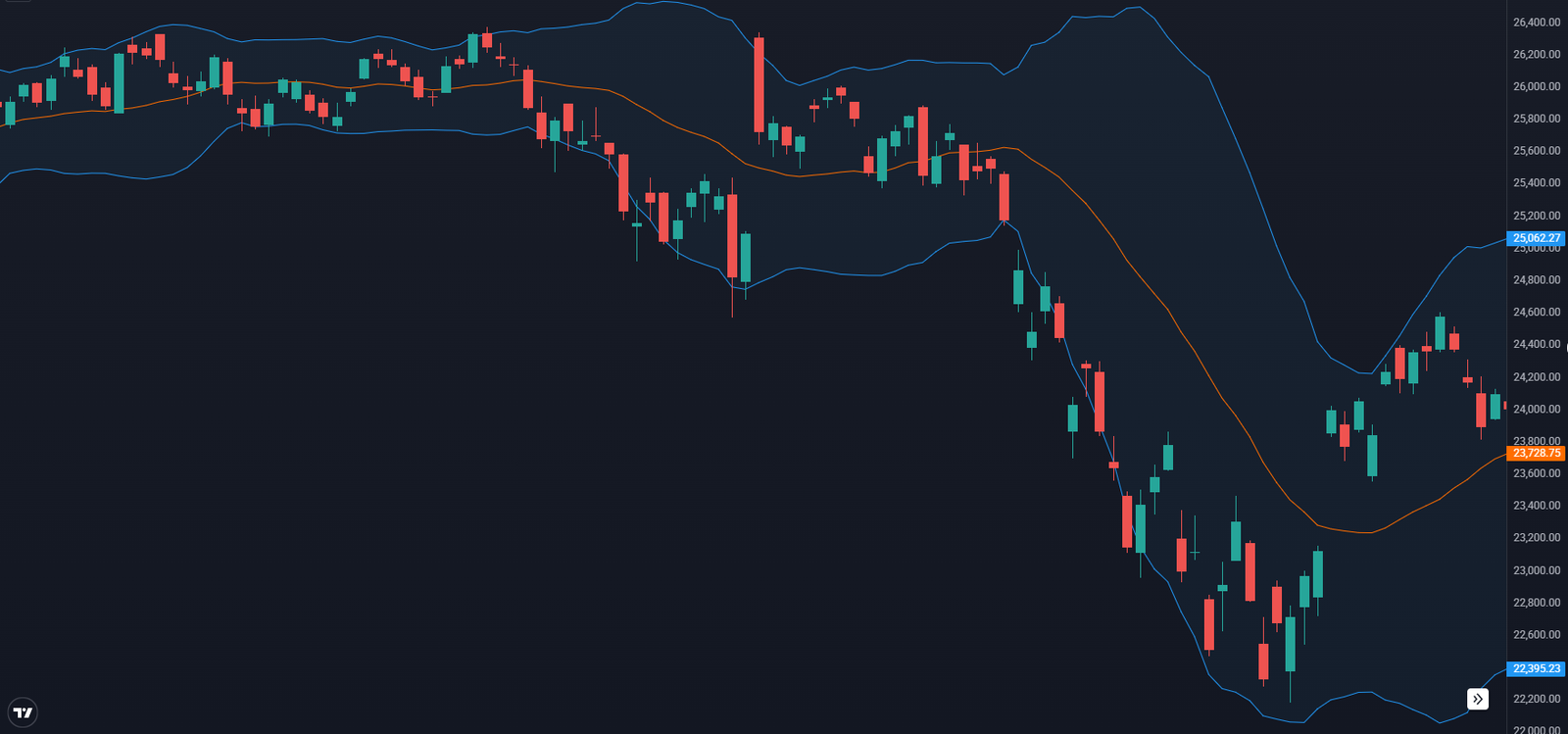
The market opens. The asset’s price begins to drop rapidly toward your identified support zone. This is where the Bayesian updating process activates. You must analyze the characteristics of this drop to gather your “Likelihood” data.
There are two primary forms of new evidence you must evaluate: Velocity (Momentum) and Participation (Volume).
Scenario A: Confirming Evidence
As the price approaches your support zone, you notice that the candlesticks are getting smaller. The downward momentum is drying up. You look at an oscillator—like the Relative Strength Index (RSI)—and notice that it is beginning to flatten out and form a bullish divergence. Furthermore, the overall trading volume is incredibly light.
This new data strongly supports your initial thesis. The lack of selling volume indicates that major institutions are not aggressively liquidating their positions. The drying momentum shows that sellers are exhausted.
- Bayesian Update: You take your initial 65% Prior Probability, factor in this highly supportive new evidence, and your Posterior Probability updates to 80%. You execute the trade with extreme confidence.
Scenario B: Degrading Evidence
Now imagine the alternative. As the price approaches your support level, a negative news headline hits the wires regarding the broader banking sector. Suddenly, the asset begins printing massive, wide-range red candlesticks. The volume bars at the bottom of your screen explode to three times their normal average. The RSI plunges violently downward without any sign of divergence.
This new evidence is catastrophic to your initial thesis. The massive volume indicates that large institutional funds are aggressively dumping the asset. The velocity of the red candles shows absolute panic.
- Bayesian Update: You do not stubbornly stick to your 65% historical win rate. You feed this new, terrifying evidence into your mental model. Your updated Posterior Probability plummets from 65% down to 20%. The trade is mathematically invalidated before it even triggers. You cancel your limit order, step aside, and protect your capital.
By constantly reading the live momentum and volume as new data, you avoid stepping in front of institutional freight trains. You no longer buy “broken” support levels, because your Bayesian model warned you that the probabilities had shifted long before the level actually broke.
The Threat of Analysis Paralysis
While Bayesian updating is the most intellectually robust way to view the financial markets, it comes with a severe psychological danger for retail traders.
If you are constantly updating your probabilities every time a new 1-minute candle prints, you will eventually drive yourself insane. You will suffer from crippling analysis paralysis.
Imagine you enter a long trade based on a strong 80% Posterior Probability. Five minutes later, a single, slightly larger-than-average red candle prints. If you over-react to this minor piece of new data, you might downgrade your probability to 40% and panic-sell your position. Ten minutes later, the market resumes its upward trend, and you are left sitting on the sidelines with a loss, realizing you were shaken out by random market noise.
A true Bayesian model requires a filter. It requires you to differentiate between “statistically significant new evidence” and “random algorithmic noise.”
To prevent yourself from constantly second-guessing your trades and manually closing positions prematurely, you must introduce a rigid, mechanical anchor to your trading system. You must marry the fluid, dynamic logic of Bayesian probability with the cold, unyielding mathematics of fixed-point risk management.
Strict Execution: Marrying Bayesian Logic with Fixed-Point Risk
The single most effective way to eliminate analysis paralysis while trading a Bayesian framework is to remove all percentage-based, subjective risk management from your charts.
Amateur traders often attempt to manage risk using loose percentages, saying things like, “I will hold this trade as long as it doesn’t drop by 2%,” or “I will exit if the chart looks weak.” This subjectivity invites emotional destruction. When new data arrives, fear will always convince you that the chart “looks weak,” forcing you to abandon perfectly valid trades.
To trade like an elite proprietary firm, your risk parameters must be locked into the structural geometry of the asset’s price movement. You must utilize rigid fixed-point parameters.
Regardless of what new intraday data arrives after you have entered the trade, your entire execution system must operate on a strict 400-point target and a 200-point stop loss.
Here is how this structural anchor protects your Bayesian model:
- The 200-Point Stop Loss (The Ultimate Failsafe): Before you enter the trade, you use your Bayesian model to ensure the probability of success is high. Once you execute, you immediately place a hard, automated stop loss exactly 200 points against your entry.Once that order is in the system, you stop analyzing minor ticks. If a piece of negative news hits the wire and the market drops 50 points, your Bayesian probability might decrease, but you do not touch the trade. You allow the market to breathe. You accept that your model might be temporarily wrong. Only if the new evidence is so overwhelmingly powerful that it drives the asset a full 200 points against you does the trade terminate. The 200-point violation is absolute, undeniable proof that your Bayesian thesis was incorrect. It removes all human emotion from the exit.
- The 400-Point Target (The Probability Realization): Similarly, you place an automated take-profit order exactly 400 points above your entry. As the trade moves in your favor, new data will constantly arrive. You might see a momentary volume spike against your position, tempting you to close the trade early and secure a tiny 100-point profit. You must resist this urge.You established a high-probability entry; now you must let the math play out. By enforcing a strict 400-point target, you guarantee that when your Bayesian model is correct, it captures maximum value.
By enforcing this 400-point target and 200-point stop loss, you create an unbreakable 1:2 Risk-to-Reward ratio.
This is the ultimate secret of quantitative trading. You use fluid, dynamic Bayesian logic to select the absolute best entries, but the moment the capital is deployed, you switch to a rigid, mechanical fixed-point risk structure. You allow the probabilities to resolve themselves within a protected, mathematical cage.
The Evolution of the Trader
The transition from a frequentist trader to a Bayesian trader is the transition from gambling to professional underwriting.
You must stop demanding absolute certainty from the market. The market owes you nothing, and it will constantly change its behavior based on macroeconomic shifts, credit cycles, and institutional rotation. If you stubbornly cling to a static thesis because a chart pattern worked three years ago, your capital will slowly be drained by those who are adapting in real-time.
Start viewing your charts as living equations. Establish your baseline prior probabilities using higher timeframe structure. When the market opens, wait for the new evidence. Read the velocity of the price action. Measure the weight of the volume. Synthesize that data to update your beliefs in real-time.
When the posterior probability aligns heavily in your favor, execute without hesitation. But the moment your capital is at risk, surrender your need to control the outcome. Let the rigid mathematics of your 400-point target and 200-point stop loss govern your survival. This is how you stop predicting the market, and start extracting wealth from its continuous evolution.