
Capital Rotation Models: How Funds Shift Money Across Sectors Before Trends Begin
If you want to understand why you are constantly buying the top of a market just before it crashes, or selling the bottom right before a massive rally, you have to fundamentally change how you view the stock market.
Most retail traders view the stock market as a single, monolithic entity. They look at the benchmark index, check if the daily candle is green or red, and make their decisions based on that single data point. If the broader market is going up, they assume everything is healthy. If the broader market is going down, they panic and assume the financial system is collapsing.
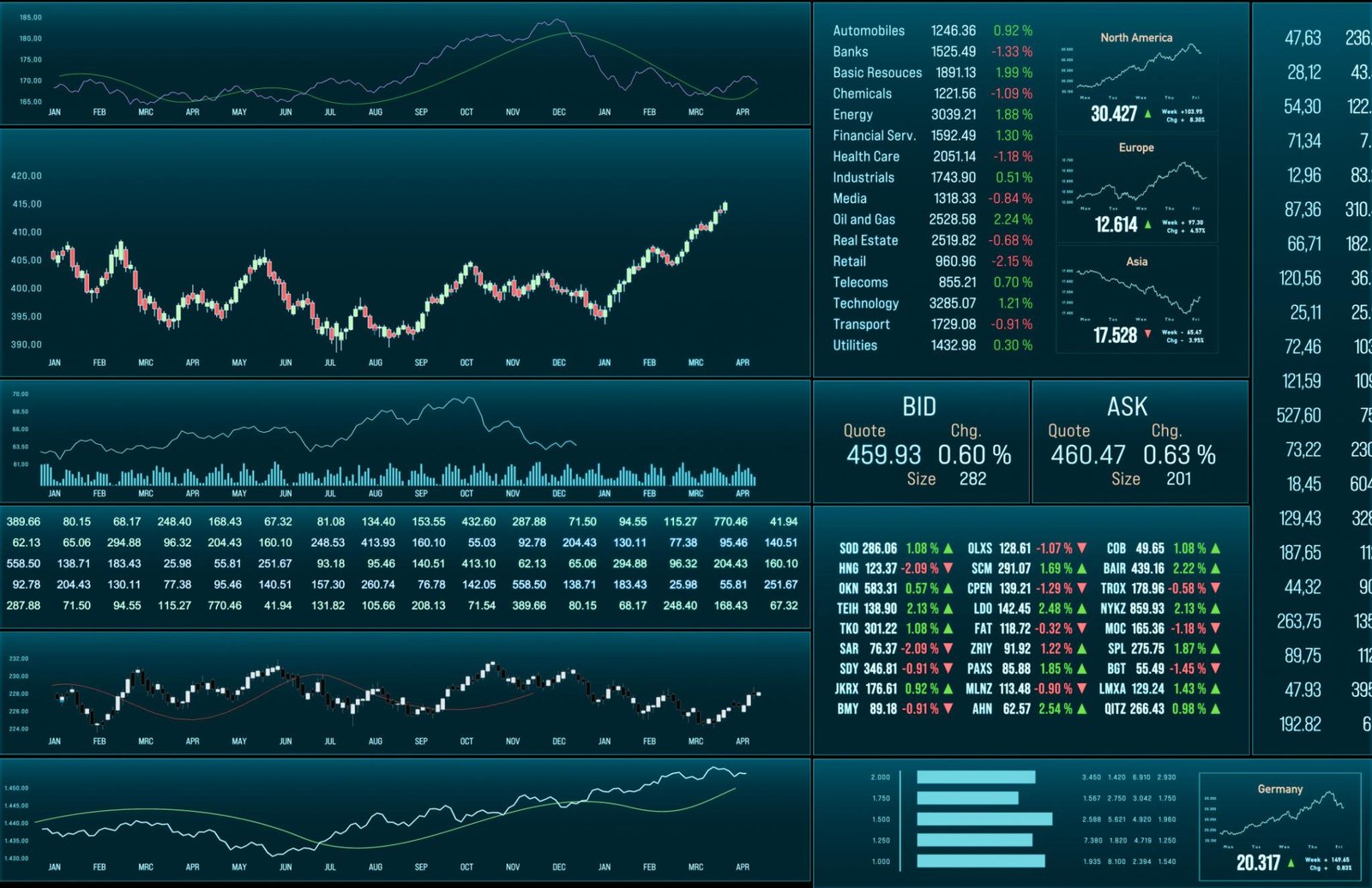
This is a dangerous, amateur illusion. The benchmark index is nothing more than a mathematical average. It is a blanket thrown over a highly complex, constantly moving machine. Underneath that blanket, the market is severely fragmented into distinct, individual sectors—technology, healthcare, energy, utilities, real estate, and more.
When you understand that the market is a collection of sectors rather than a single unified asset, you unlock the secret to institutional trading: Capital Rotation. Massive investment funds, banking institutions, and hedge funds do not trade the benchmark index the way you do. They rotate their billions of dollars from one sector to another, quietly building positions weeks or months before the retail crowd ever notices a trend.
If you want to stop reacting to the market and start anticipating it, you must learn how to track capital rotation. You need to read the footprints of institutional money as it quietly shifts across the board.
The “Trapped Capital” Reality of Institutional Funds
To understand why capital rotation happens, you have to understand the core problem that a multi-billion-dollar fund manager faces.
When a retail trader gets scared of the market, they click a button, sell all their positions, and move 100% of their account into cash. They can do this in three seconds.
A massive mutual fund or pension fund cannot do this. They are managing billions in capital. If they were to suddenly sell all their equity holdings to move into cash, their massive sell orders would instantly crash the market, destroying their own portfolio value in the process. Furthermore, their legal mandates and prospectuses often require them to stay fully invested in the market at all times. They are literally not allowed to hold 100% cash.
So, what does a fund manager do when they believe the current market cycle is ending and risk is high? They cannot leave the casino. Instead, they move their chips to a safer table.
They sell their highly aggressive, overvalued technology or consumer discretionary stocks, and they quietly use that capital to buy boring, defensive sectors like utilities, consumer staples, or large insurance companies. This process is a zero-sum game of constant motion. Capital is never truly created or destroyed in the short term; it simply migrates.
When you see the benchmark index trading perfectly flat for three weeks, retail traders assume the market is dead and boring. In reality, under the surface, billions of dollars are violently rotating out of growth sectors and into defensive sectors. By the time the benchmark index finally breaks down, the smart money has already positioned itself to profit from the safety of their new sector.
The Economic Business Cycle and Sector Flow
Capital rotation is not random. It follows a highly logical, predictable sequence tied directly to the macroeconomic business cycle. While you do not need an economics degree to trade, you must understand the basic sequence of how money flows through the economy to anticipate where the funds will move next.
1. The Early Recovery Phase When the economy is just starting to bounce back from a recession, interest rates are usually low, and credit is cheap and easy to access. During this phase, fund managers aggressively rotate capital into sectors that benefit most from low borrowing costs and consumer spending. You will see massive volume flowing into technology, consumer discretionary (retail, automobiles), and housing.
2. The Mid-Cycle Phase As the recovery stabilizes, economic growth peaks. Companies are expanding, and factories are running at full capacity. Here, the smart money begins to take profits from the early tech runners and rotates capital into industrials, basic materials, and the broader financial sector. Banking institutions begin to thrive here as loan demand remains strong and they anticipate future interest rate hikes.
3. The Late-Cycle Phase The economy begins to overheat. Inflation rises, and central banks begin to tighten credit by raising interest rates. Growth slows down. This is where fund managers start playing defense. They rotate heavily out of consumer discretionary and technology—sectors that rely on cheap debt. Instead, they pour capital into energy, commodities, and healthcare. These are sectors that either benefit from inflation or provide services that consumers are forced to buy regardless of the economy.
4. The Recessionary Phase When the economic contraction hits, fear takes over. But remember, the massive funds cannot go entirely to cash. They rotate into the ultimate defensive bunkers: utilities and consumer staples (food, toothpaste, basic necessities). These sectors offer high dividends and absolute stability.
If you know what phase of the business cycle the economy is transitioning into, you already know which sectors the institutions are quietly buying.
The Benchmark Illusion: Why Retail Always Misses the Move
Let’s look at exactly how retail traders get trapped by looking at the wrong data.
Most major benchmark indices are market-capitalization-weighted. This means that the largest companies in the index mathematically control the direction of the index. If a few massive technology giants are having a great week, the benchmark index will print massive green candles and break out to all-time highs.
A retail trader looks at this chart, feels massive FOMO (Fear Of Missing Out), and decides to aggressively invest their capital into the market, thinking a massive bull run has started.
But if that retail trader had looked at the sectoral charts, they would have seen a terrifying divergence. They would have noticed that while the tech sector was pushing the index up, the transportation sector, the banking sector, and the industrial sector were actually breaking down through major support levels.
The institutional money was using the final, euphoric push in the tech giants as “exit liquidity.” They were selling their tech shares to the retail traders at absolute top prices, and quietly using that cash to build short positions in industrials or buy defensive utilities.
A week later, the tech sector finally exhausts itself, and the entire benchmark index collapses. The retail trader is left holding a massive loss, wondering how a “perfect breakout” failed. It failed because the foundation of the market was already hollowed out by capital rotation weeks prior.
Building Your Rotation Tracking Model
You do not need a twenty-thousand-dollar institutional data terminal to track capital rotation. You just need to change your daily charting routine.
Instead of opening your trading software and immediately looking at the main benchmark index, you must build a specific watchlist of Sector ETFs (Exchange Traded Funds) or Sector Indices. Every major stock exchange provides specific indices that track only the banks, only the IT companies, only the pharma companies, and so on.
Your goal is to scan these sector charts to find the anomaly. You are looking for the sector that is completely ignoring the broader market.
If the benchmark index has been crashing for five straight days, you want to flip through your sector charts and find the one sector that has been moving completely sideways, refusing to drop. That refusal to drop is not an accident. It means institutional buy orders are sitting right below the current price, absorbing all the panic selling. The institutions are building their bunker. When the benchmark index finally stops crashing and bounces, that specific sector will act like a coiled spring and explode upward.
The Technical Setup: Spotting the Accumulation
To make this mechanical, you need a simple, visual charting setup. You do not need to combine multiple assets or create complex ratio spreads. You just need a standard sector chart and a classic momentum indicator used correctly.
The most effective tool for spotting quiet, institutional accumulation before a massive sector trend begins is the Moving Average Convergence Divergence (MACD).
However, you are not going to use the MACD on a 5-minute or 15-minute intraday chart. Institutional capital rotation takes weeks to unfold. You must apply the MACD to a Daily or Weekly timeframe sector chart.
Here is the setup:
- Open a chart for a specific sector (for example, the Energy Sector Index).
- Set the timeframe to Daily.
- Apply the standard MACD indicator (Settings: 12, 26, 9).
You are looking for a Hidden Momentum Divergence.
Imagine the benchmark index is making new lows, and the Energy Sector chart is also slowly bleeding downward, making lower lows. The retail crowd assumes the Energy sector is dead. But when you look at your MACD indicator at the bottom of the screen, the histogram bars are actually getting smaller, and the MACD lines are beginning to curve upward, making a higher low.
This is the footprint of smart money. It tells you that while the price is technically still dropping, the actual downward momentum has completely evaporated. The selling pressure is exhausted, and institutions are quietly accumulating shares at discount prices. The moment the MACD lines cross bullishly on the daily chart, the capital rotation is officially complete, and the markup phase is about to begin.
Volume Confirmation: The Ultimate Proof
If you want to add a layer of absolute certainty to your capital rotation model, you must look at volume. Price can be manipulated in the short term, but volume cannot be hidden. When billions of dollars flow into a sector, it leaves a permanent mark on the volume tape.
To track this without cluttering your chart with complex volume profile tools, you can simply use the On-Balance Volume (OBV) indicator.
The OBV is a cumulative indicator. On days when the sector closes green, the day’s volume is added to the OBV line. On days when the sector closes red, the volume is subtracted.
Apply the OBV to your Daily sector chart. If a sector has been trading in a boring, flat, sideways consolidation range for three months, most traders will ignore it. But if you look at the OBV indicator and see that the line is steadily climbing upward at a 45-degree angle despite the flat price action, you have found a goldmine.
This means that on the days the sector ticks up, massive institutional volume is buying. On the days it ticks down, the volume is incredibly light. They are buying heavy and selling light. The capital has arrived, and it is only a matter of time before the price chart violently breaks out of the consolidation box to catch up with the volume flow.
Strict Execution and Fixed-Point Risk Management
Once you have identified the sector that institutional capital is rotating into using MACD divergence and OBV accumulation, you must execute the trade. You can do this by trading the sector ETF directly, or by identifying the top two or three heaviest-weighted stocks within that specific sector and trading their derivatives.
However, finding the right sector is only half the battle. If your risk management is flawed, even the best capital rotation model will fail to protect your account.
Amateur traders often attempt to manage their trades using arbitrary percentage-based rules, such as “I will risk 2% of my total account balance on this trade” or “I will cut the trade if the asset drops by 5%.” This is an emotional, sloppy method that ignores the actual structural geometry of the chart. It forces you to place stop losses in random locations that institutions will easily hunt and trigger.
To trade alongside the institutions, you must abandon percentage-based risk parameters in favor of rigid, mathematical fixed points.
Your entire trading system must operate on a predefined, non-negotiable fixed point structure. For an optimal, institutional-grade risk-to-reward ratio, you must utilize a strict 400-point target and a 200-point stop loss based on the underlying asset’s point movement.
- The 400-Point Target: When you enter the sector breakout, you calculate exactly 400 points of upward movement from your entry price. This is your automated take-profit zone. You do not hold the position indefinitely hoping the trend goes on forever. You do not get greedy. When the asset travels 400 points, the capital rotation move has provided its primary markup, and you ruthlessly extract your profit from the market.
- The 200-Point Stop Loss: Immediately upon entry, you place a hard stop loss exactly 200 points below your execution price. This is your structural failsafe. If the asset moves 200 points against you, it mathematically proves that your capital rotation thesis was incorrect. Perhaps the institutional accumulation was a fake-out, or a sudden macroeconomic shock forced funds to rapidly liquidate. You do not check the news, you do not hope for a bounce, and you do not widen your stop. The 200-point violation takes you out of the trade instantly.
By strictly enforcing the 400-point target and 200-point stop loss, you create a flawless 1:2 Risk-to-Reward environment. You are mathematically insulated. You can be wrong on half of your capital rotation predictions, suffer multiple stop-outs, and still generate substantial, compounding wealth over a large sample size of trades because your winning rotations will always mathematically eclipse your losses.
The Mindset Shift
Trading capital rotation requires extreme patience. It is not designed for the hyper-active scalper who wants to make a quick profit in three minutes. It is a strategic, calculated approach to wealth generation.
You must accept that the real money is not made by reacting to the benchmark index breaking out on the television news. The real money is made in the quiet, boring, sideways charts where the finance giants are silently parking their capital.
Stop staring blindly at the primary index. Break the market down into its component sectors. Apply your daily momentum indicators, watch the volume accumulate, respect your strict 400-target and 200-stop parameters, and position your capital exactly where the smart money is going, right before the rest of the world realizes it.